In 2025 the Health Research Authority asked people working across health and social care research in the UK about their experience of study set-up.
The results of the survey gave us valuable insight into the impact of the improvements we are making as part of the UK Clinical Research Delivery (UKCRD) programme, our work to develop our digital research systems, and our new strategy, to speed up the study set-up process.
We committed to repeating the survey on an annual basis to track improvements and identify where we need to prioritise our efforts.
2026 survey
Our second annual survey was carried out between March and April 2026.
The site set-up survey looks at how the health research sector is experiencing study set-up at sites.
It focusses on six areas that we aim to influence through our work to improve study set-up in the UK.
(BOX – Sites are now known as locations following a change in terminology introduced in the recent updates to the Clinical Trials legislation in the UK. For the purpose of this report and for consistency with the previous survey we will continue to use 'sites'.)
Questions we asked
In the survey we asked a series of questions under the following themes:
- ease – how easy is it to set up studies?
- clarity – how clear are processes when setting up studies?
- consistency – how consistent was your experience across sites and settings?
- expectations – are studies usually set up in the way you expect them to be?
- efficiency – how efficient is the set-up process, is there unnecessary duplication?
- speed – how fast is it to set up studies?
Under each question we also asked respondents a series of follow up questions to see if their experience differed depending on what part of the research sector they worked in.
You can take a look at the results for each of these themes by clicking on each heading.
Response rate
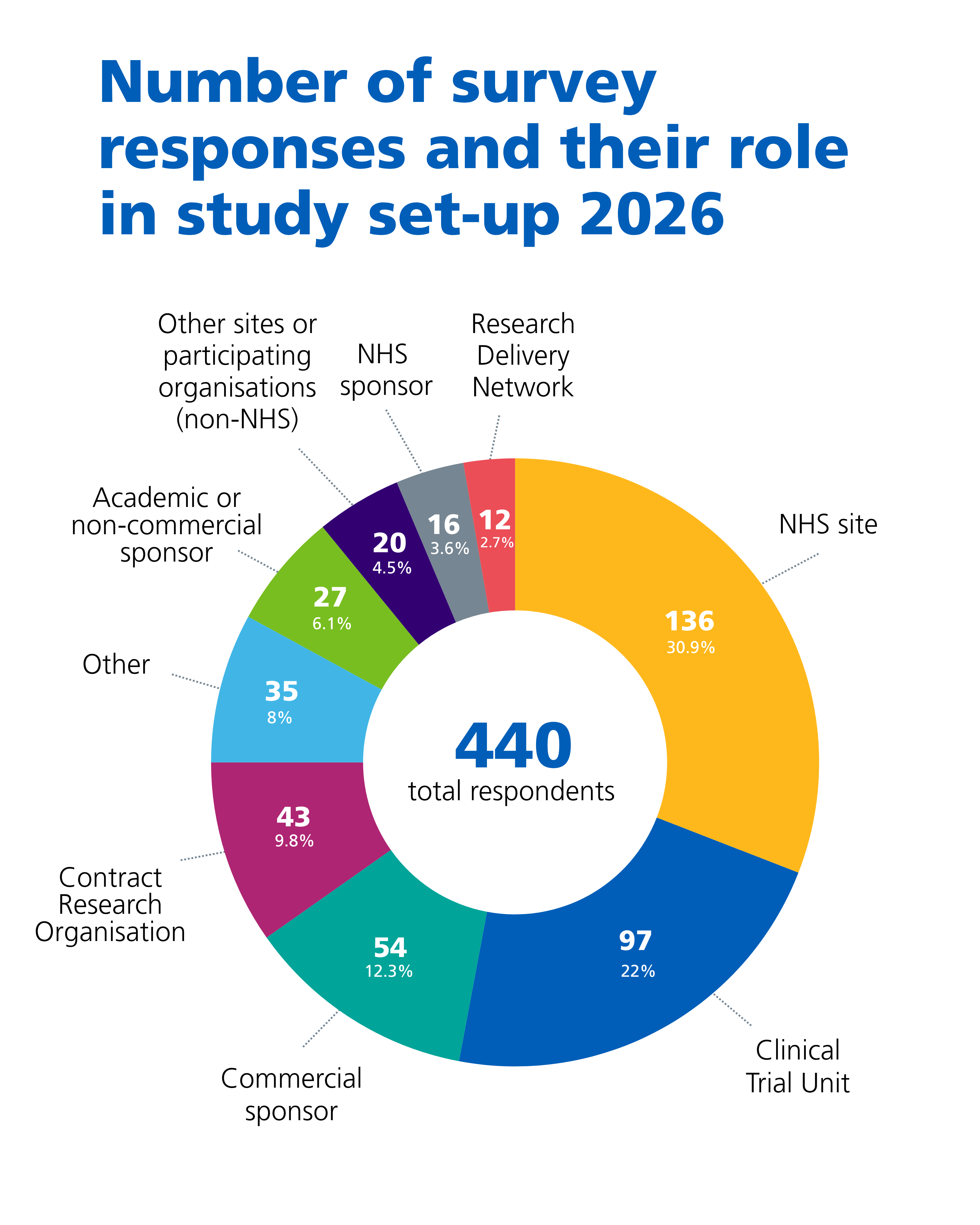
In total we received 440 responses to the survey.
We asked respondents what their role was in study set-up using the following categories:
- NHS site – 136 responses (30.9%)
- Clinical Trials Unit – 97 responses (22%)
- Commercial sponsor – 54 responses (12.3%)
- Contract Research Organisation – 43 responses (9.8%)
- Other – 35 responses (8%)
- Academic or non-commercial sponsor – 27 responses (6.1%)
- Other sites or participating organisations (non-NHS) – 20 responses (4.5%)
- NHS sponsor – 16 responses (3.6%)
- Research Delivery Network (for example RRDN) – 12 responses (2.7%)
Those who selected the ‘other’ category told us they were either an individual working in the NHS or in research, (for example a research nurse, chief investigator or public contributor in research) local government or they were working in other research support functions.
Methodology
This year we updated the survey methodology to reflect feedback we received from the UK Study Set-Up Advisory Board.
Whilst the questions asked in 2025 broadly remained the same, we have changed the options available to respondents.
Rather than using a Likert scale out of 10, we have changed to a more sentiment-based scale of agree or disagree to make answers clearer.
We also asked for more qualitative feedback on improvements that respondents had experienced, and added a more detailed analysis of the difference in results between sites and applicants, and commercial and non-commercial sectors.
This change in methodology means that we cannot directly compare the results from 2025 to 2026.
We have committed to using this methodology going forward which means that the 2026 results form a new baseline for us to work with going forward, and we will be able to measure progress in the 2027 survey.
Some percentages in the charts below may not add up to 100% due to rounding.
Definitions
Throughout the survey we have grouped respondents together to see if any themes emerge when comparing these groups.
We have grouped respondents together as follows:
- commercial – commercial sponsors, Contract Research Organisations (CROs) and Commercial Clinical Trials Units (CTUs)
- non-commercial – academic or non-commercial sponsors, NHS or HSC sponsors, academic or non-commercial CROs, NHS or HSC CROs, academic or non-commercial CTUs and NHS or HSC CTUs
- NHS – NHS sponsors and NHS sites
- applicants – sponsors, CROs and CTUs
- sites – sites and Regional Research Delivery Networks (RRDNs)
150 day clinical trial set-up target
In 2025, the Life Sciences Sector Plan was launched, outlining a target for clinical trials in the UK to be set-up within 150 days by March 2026.
This ambitious target saw the research community in the UK come together, and through initiatives like the UKCRD programme deliver improvements that have significantly sped up the set-up process for research.
As of April 2026, the average time to set up a study in UK was 122 days.
Whilst this survey has not been designed to ask questions specifically about awareness of the 150 day target, the results should be looked at in the context of the range of work that has been carried out sector wide to help achieve this target.
Summary of findings
When reviewing the feedback from the survey it is clear to see that respondents recognised the ongoing efforts to improve the study set-up process in the UK, but that the improvements have not yet resolved longstanding issues and will take time to bed in.
This is reflected in a significant proportion of respondents giving neutral or uncertain answers to questions throughout the survey.
Feedback showed some improvement in the speed and efficiency, but set-up remains slower than respondents expect it to be where research is carried out across multiple sites.
Initiatives such as NCVR, plus new and updated UK-wide contracts, were welcomed, as well as support for parallel processing where set-up is starting to happen earlier and in parallel to regulatory reviews.
Concerns remain around consistency, predictability and standardisation across sites, with feedback showing that processes were still being duplicated, leading to inefficient set-up.
We also found that resourcing and capacity issues in NHS and HSC organisations continue to be a real challenge for research delivery.
One of the key themes that emerged during our analysis was a difference between commercial and non-commercial studies.
Respondents from commercial studies generally responded more positively, whereas non-commercial studies responded less favourably. This is also borne out in some of the qualitative answers where there was a perception that non-commercial studies had not been prioritised.
Generally, applicants and sites felt similarly across nearly all questions when we looked at their positive responses, however, applicants gave fewer neutral responses and instead reported more negatively for most questions.
The exception to this was for studies across different settings where sites and applicants were aligned in finding the process difficult or very difficult. Sites also reported more negatively than applicants when asked about consistency of set-up across sponsors.
This was also the case when comparing NHS responses with responses from all other sectors. The NHS was generally more positive or neutral (and less negative) that others who responded, except when asked about consistency of study set-up from regulators and UK guidance, where the NHS reported this to be more difficult than everyone else.
Summary of findings by question
Below we summarise the results for questions under each theme.
We also provide a more detailed breakdown of answers to each question, as well as a looking at differences between respondents working in different parts of health and social care research.
Ease
In this section of the survey we asked respondents generally, how would you rate the ease of setting up:
- single centre studies within an NHS or HSC site (including out of hospital NHS settings) in the UK
- studies across multiple NHS or HSC sites (including out of hospital NHS settings)
- studies across multiple settings, which include sites that are not NHS or HSC organisations
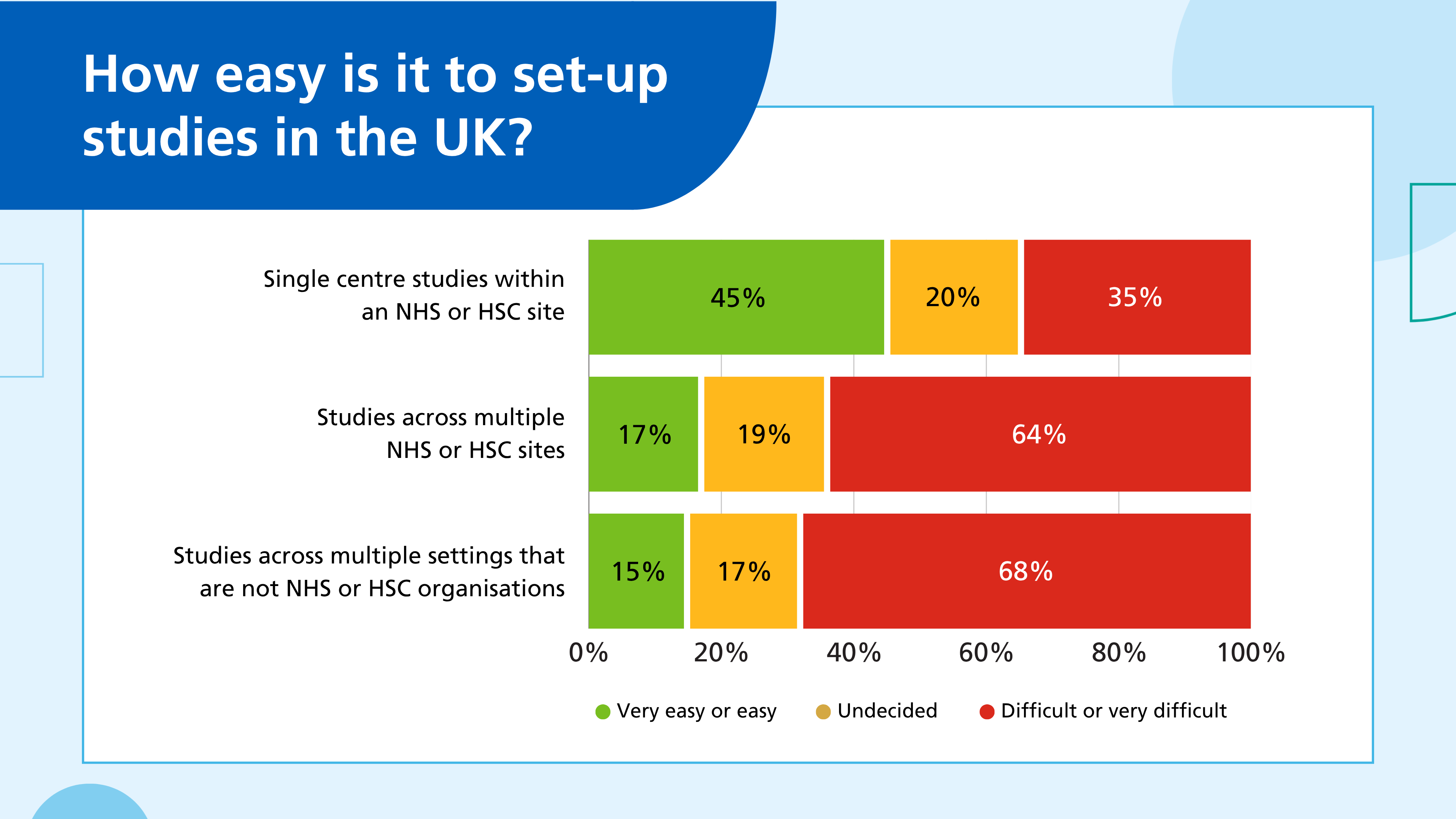
45% of all respondents said it was either easy or very easy to set up a study at a single NHS or HSC site.
When it came to rating how easy it was to set up a study across multiple NHS sites this fell to 17% of overall respondents rating the process as easy or very easy.
64% reported that it was difficult or very difficult to set up across multiple NHS or HSC sites.
This rose to 68% for respondents saying it was difficult to set-up across non-NHS HSC organisations (68%)
Between 17% and 20% said they were undecided.
There was high alignment in answers to all questions about ease, between applicants and sponsors. Commercial applicants generally answered more positively than non-commercial applicants
Take a look at a more detailed breakdown of answers to this question.
Clarity
In this section of the survey, we asked respondents generally, how clear are the following:
- UK guidance on study set-up process
- individual sponsors processes during study set-up at site
- individual site processes during study set-up at site
For the purposes of the survey clarity was defined as how easy the information was to understand and how clearly from the outset the process could be followed.
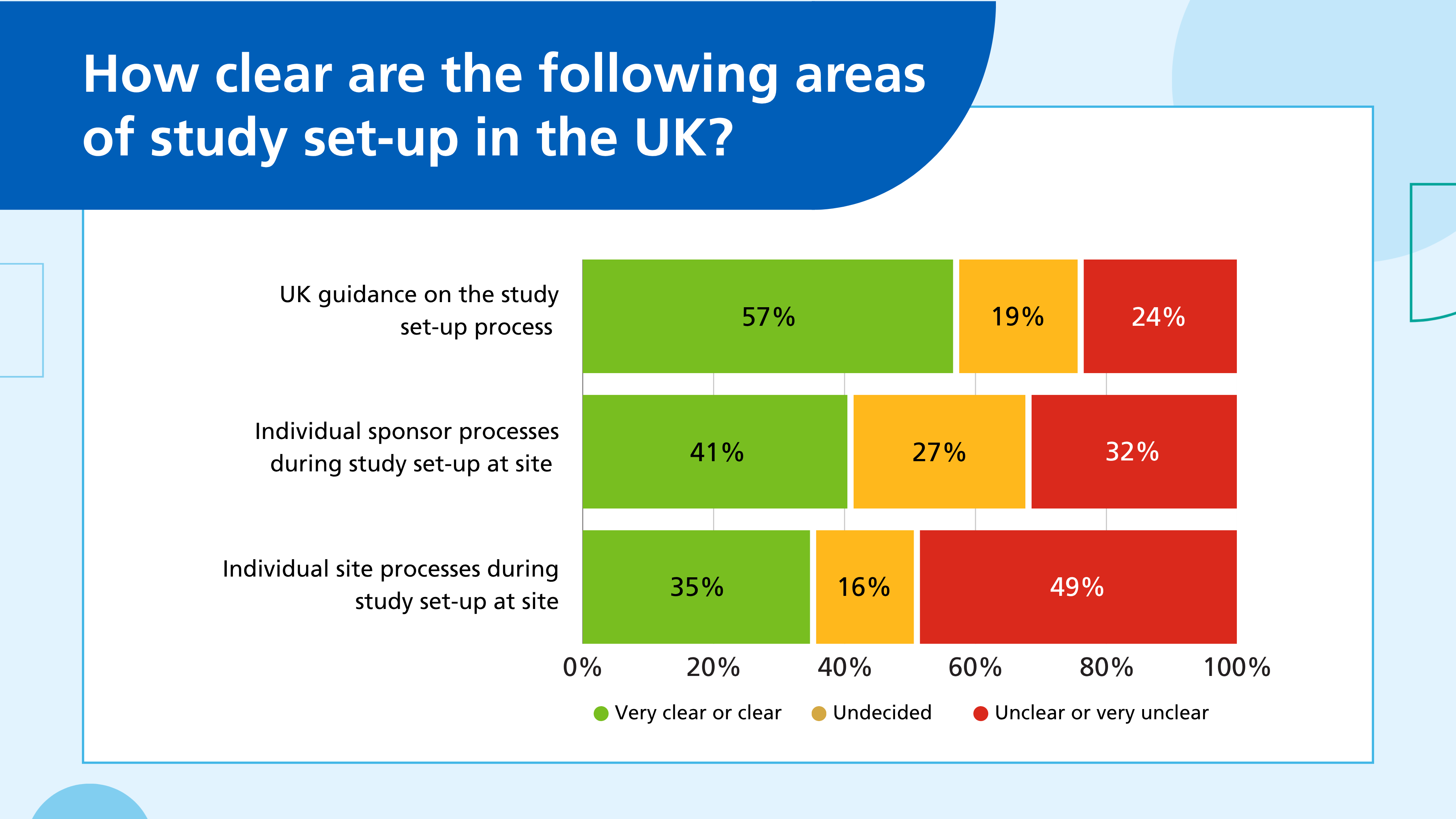
We saw a reasonably positive reaction to UK guidance on the study set-up process, with 57% of all respondents rating UK guidance to be either clear or very clear, 19% were undecided and 23% said it was unclear or very unclear.
Qualitative feedback gave us a strong message that the sector requires more coherent guidance for set-up, particularly during periods of new improvement interventions and change. NHS respondents found UK guidance for set-up less clear than everyone else.
The feedback for clarity of individual site and sponsor processes was less positive and in need of improvement.
35% of respondents found site processes to be either clear or very clear, with 49% of applicants finding site processes unclear or very unclear.
Similarly, 41% of all respondents found individual sponsor processes either clear or very clear, with nearly 32% saying sponsor processes were unclear or very unclear.
Applicants found site processes to be more unclear than sites. Equally sites found individual sponsor processes to be more unclear than applicants did.
There was minimal difference in the responses between the non-commercial and commercial sectors for this question.
Take a look at a more detailed breakdown of answers to this question.
Consistency
In this section we asked respondents, generally how consistent is your experience of study set-up from:
- regulators
- NHS or HSC sites
- sponsors
- across the UK
- studies across multiple settings (non-NHS or HSC organisations)
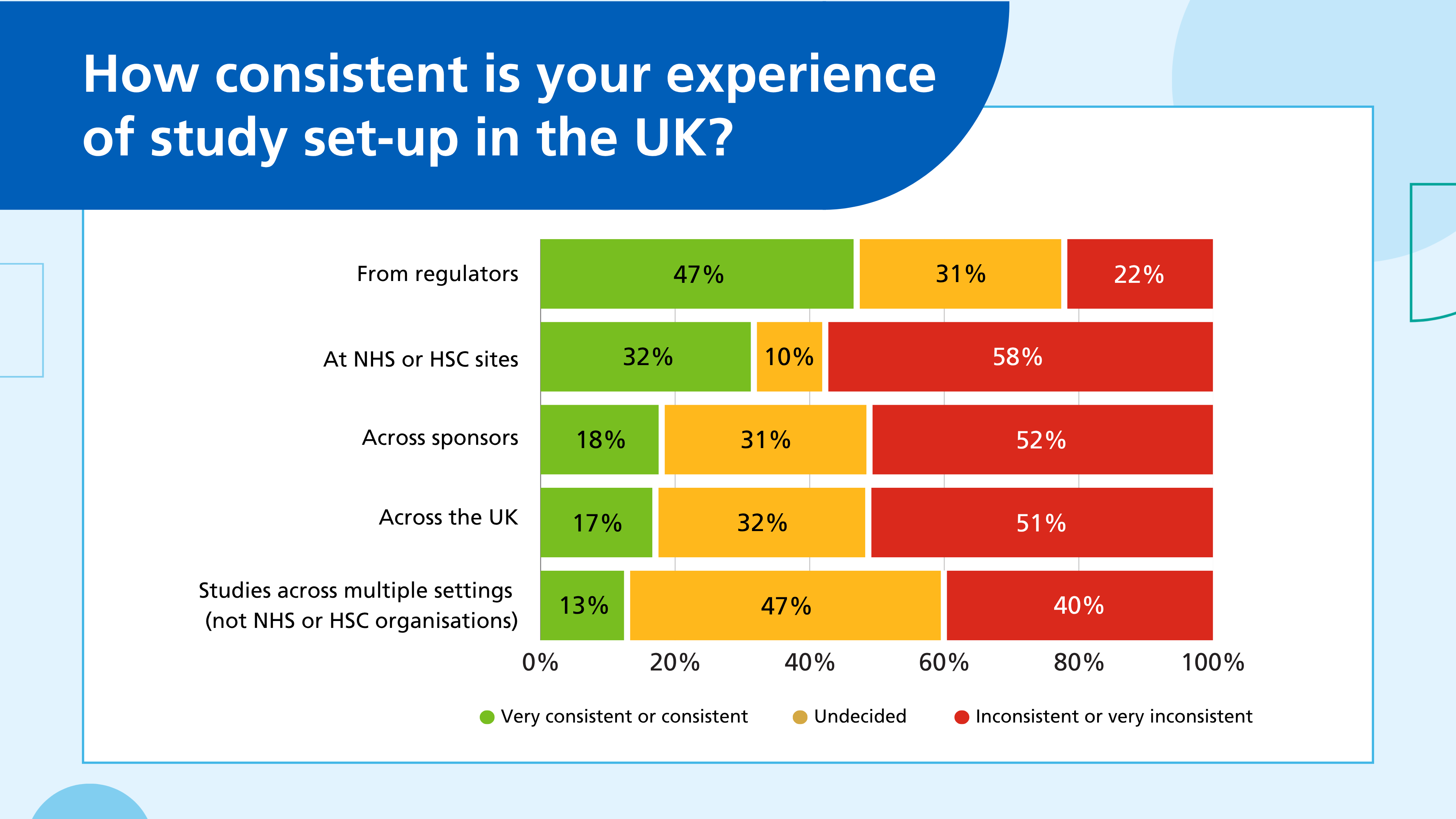
We asked respondents to think how consistent their experience of setting-up studies in different sites and settings had been over the past 12 months, with consistency defined as reliable and predictable, and whether sites and sponsors generally follow a similar process.
47% of respondents felt that regulators were very consistent or consistent during the study set-up process, 31% were undecided and 22% said it was inconsistent or very inconsistent.
Consistency from regulators was the most positively rated area.
More than 50% of respondents rated their experience at NHS or HSC sites, with sponsors or across the UK as inconsistent or very inconsistent.
40% rated their experience of studies across multiple settings (not NHS or HSC sites) as inconsistent or very inconsistent, but a much larger proportion (47%) were undecided.
Whilst responses across the sector were aligned, commercial applicants were generally more positive.
Take a look at a more detailed breakdown of answers to this question.
Expectations
In this section of the survey, we asked respondents how much their experience of study set-up in the UK met their expectations.
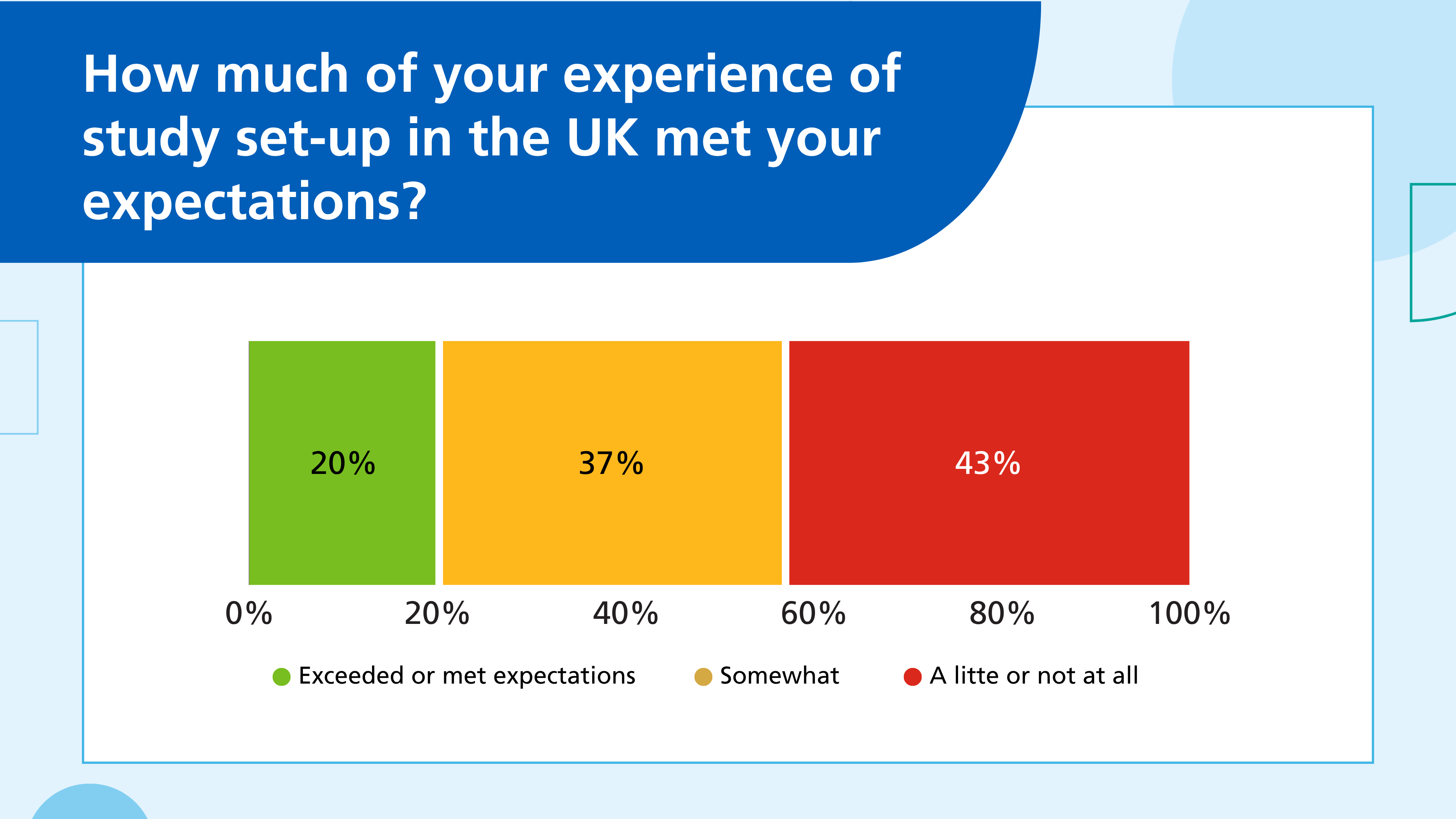
We asked respondents to think about their expectations when they have set-up research, and whether their experience met their expectations.
There was a higher level of neutrality in responses to this question compared to other questions in the survey.
37% of all respondents reported that their experience somewhat met their expectations.
Only 20% of respondents said their set-up experience exceeded or met their expectations, and 43% said it met them only a little or not at all.
Responses to this question were generally aligned between applicants and sites, and commercial and non-commercial applicants.
Take a look at a more detailed breakdown of answers to this question.
Efficiency
In this section we asked two separate questions.
The first focused on how efficient respondents considered the processes in the UK to be.
The second focussed on duplication and the effort required to set-up.
Efficient
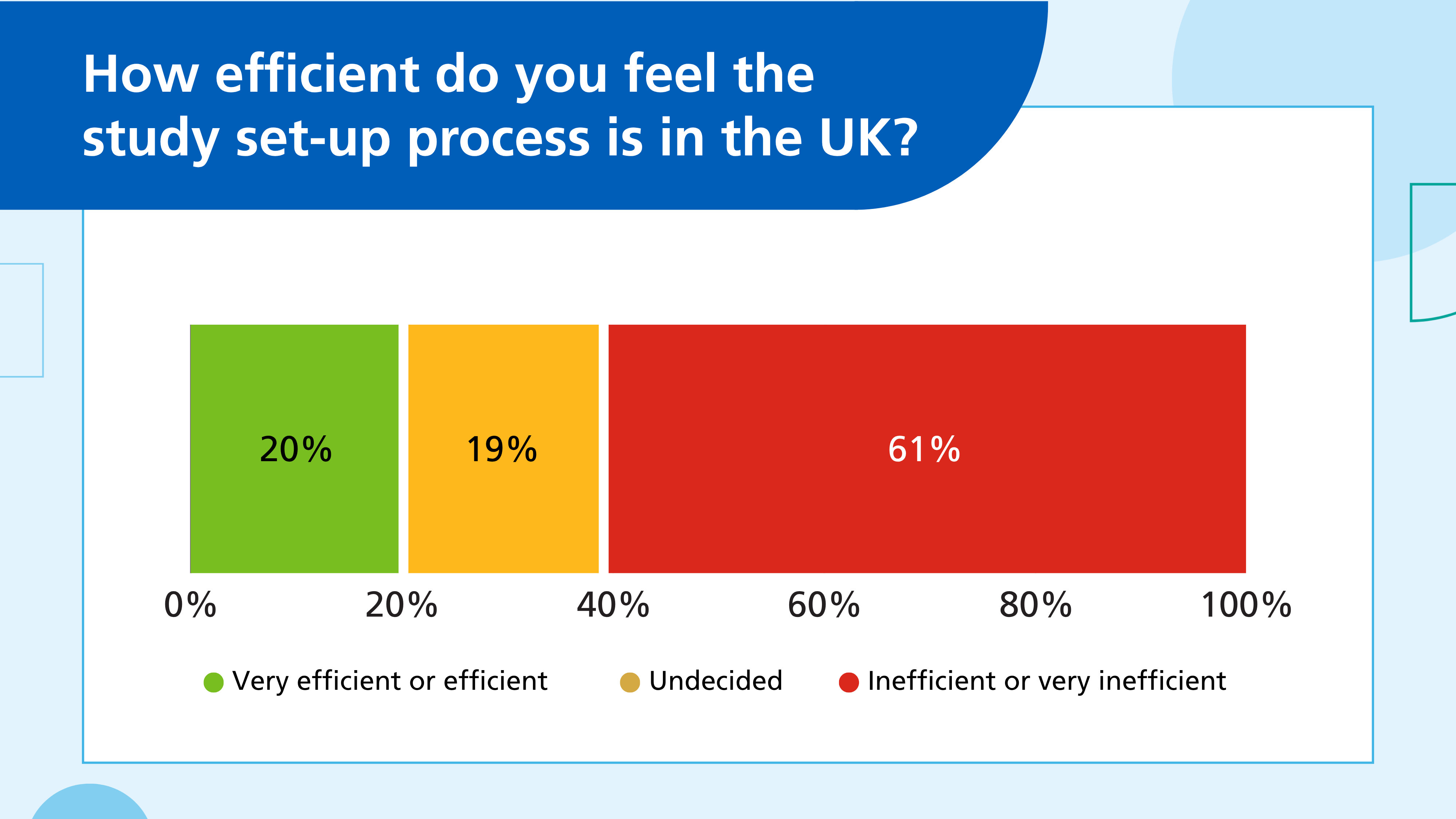
61% of respondents said the study set-up process in the UK was either inefficient or very inefficient.
19% were undecided and only 20% said that the study set-up process was very efficient or efficient.
Effort and duplication
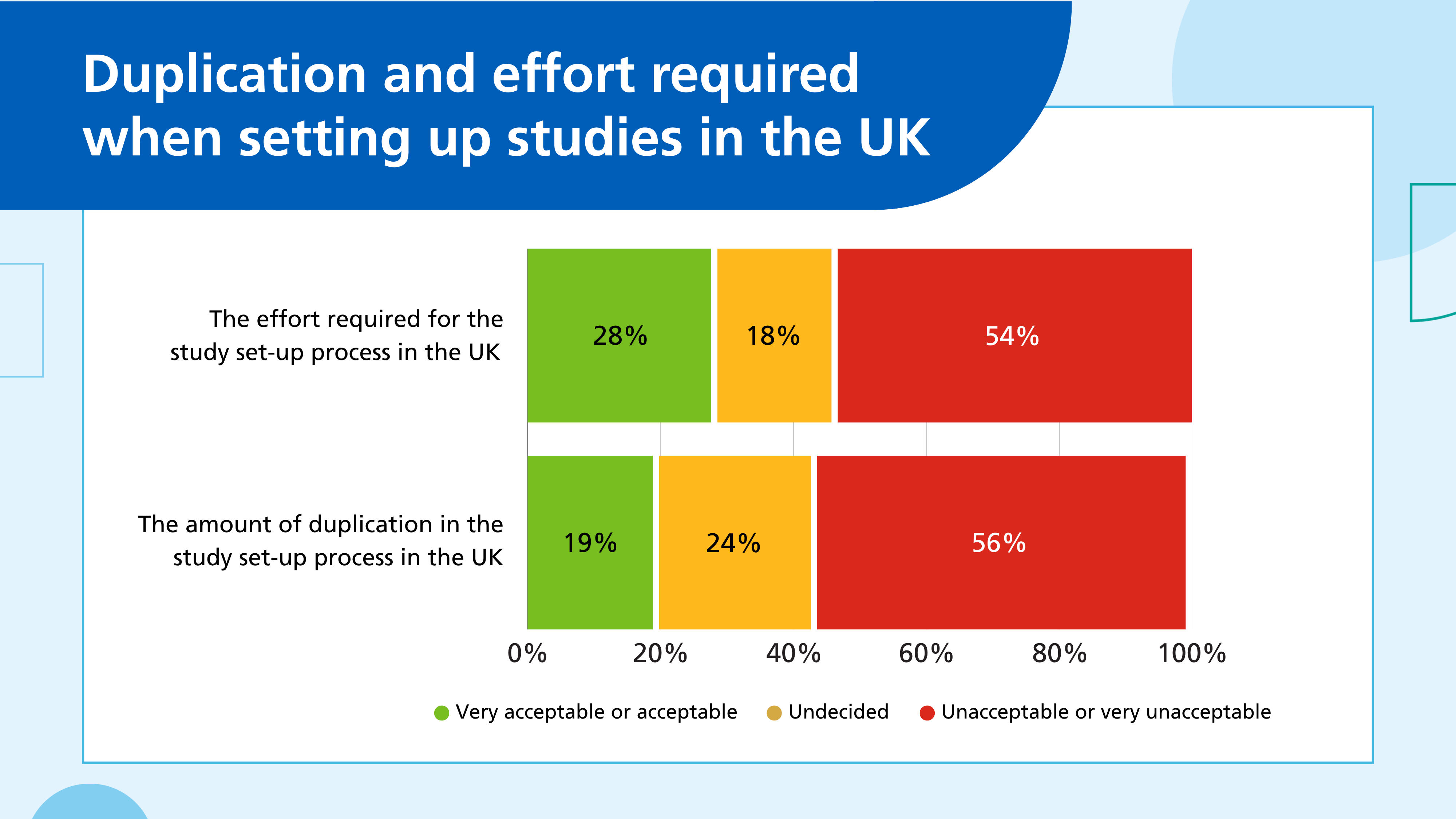
28% reported the effort required to set-up studies in the UK was acceptable or very acceptable, with just over half of all respondents (54%) reporting the effort required to be unacceptable or very unacceptable. 18% were undecided.
19% said that duplication during set-up was acceptable or very acceptable, with 56% of respondents reporting the amount of duplication in the set-up process to be unacceptable or very unacceptable. 24% were undecided.
Whilst there was generally alignment between applicants and sites for the efficiency questions, applicants reported the process to be more inefficient and more unacceptable in terms of duplication, than sites, who were more undecided.
Commercial sponsors were generally more positive than non-commercial sponsors, whilst the percentage of unacceptable or very unacceptable responses remained high.
There was a high level of alignment between the responses from the NHS and responses from all other sectors.
Take a look at a more detailed breakdown of answers to this question.
Speed
In this section we asked generally, how would you rate the speed at which studies are set-up at site within the UK?
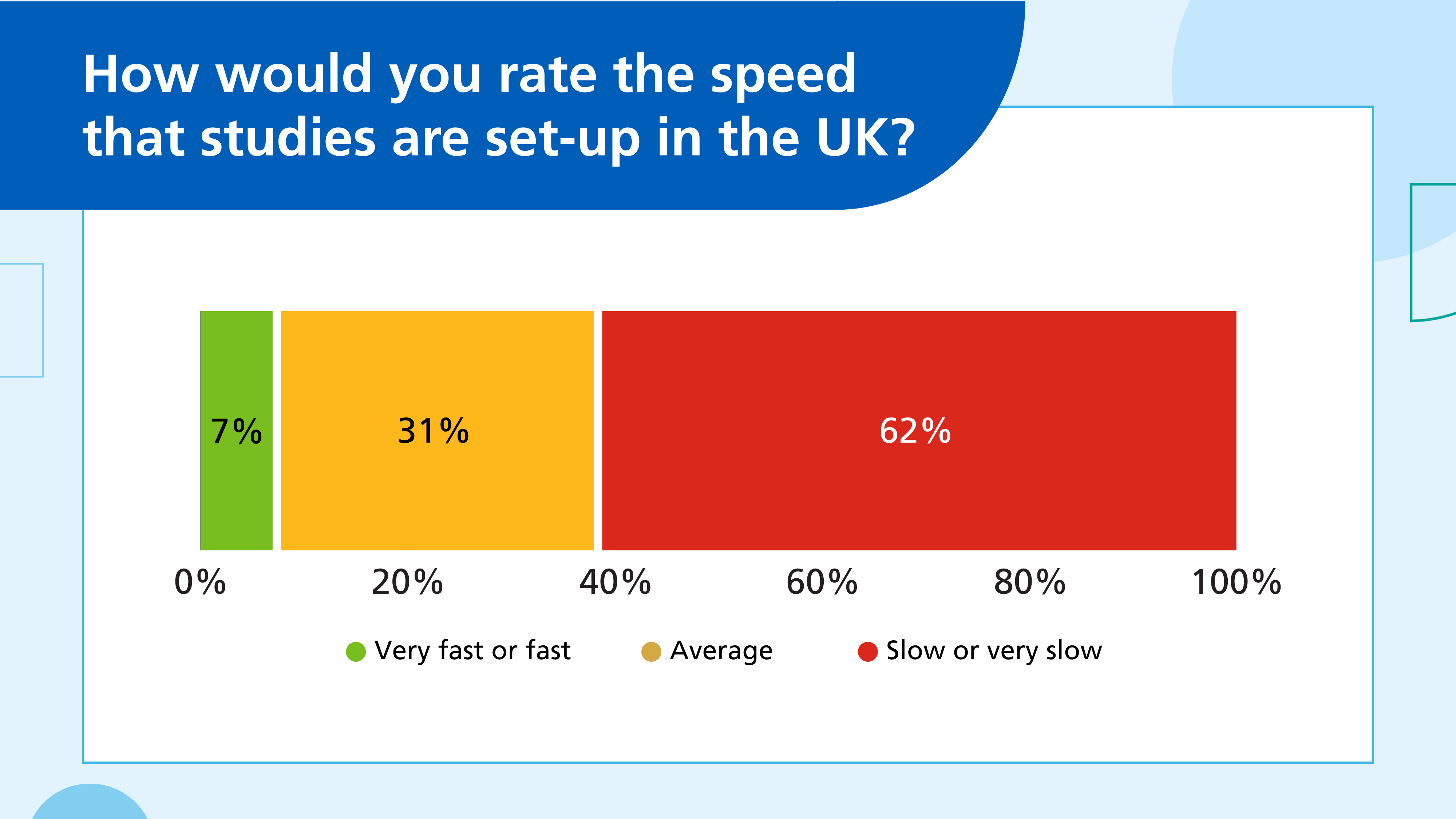
Overall quantitative responses on the speed of set-up show there remains a need for improvement to the speed of set-up.
62% of all respondents said the UK was slow or very slow, 31% said it was average, and only 7% said it was fast or very fast.
Although generally aligned, commercial applicants were more positive than non-commercial applicants, with 11% of commercial applicants rating speed to be either fast or very fast compared to only 4% of non-commercial applicants.
68% of commercial applicants said set-up was slow (45%) or very slow (23%) whereas 78% of non-commercial applicants said it was slow (35%) or very slow (43%) with more emphasis on very slow than in the commercial sector.
Take a look at a more detailed breakdown of answers to this question.
Further issues identified through the survey
When we asked respondents if they wanted to highlight any more issues in free text answers, they covered a wide range of issues in their responses.
It is important to note that this survey was not designed to identify or measure reasons, nor the extent of any underlying causes for the issues shared with us.
However, like previous responses to surveys issues of inconsistences and duplications were raised. Lack of capacity was a clear theme that emerged in this section of the survey, with recruitment and retention of the workforce negatively impacting study set-up.
Bottlenecks in pharmacy, radiation and information governance remain.