All research should be registered in a publicly accessible database.
For clinical trials, it is a condition of a favourable ethics opinion. It is good practice for all other studies.
Registering trials reduces research waste. It prevents duplication and means that more people can find out about studies to join.
Trusted information about health and social care studies should be publicly available for the benefit of all, and registration is the first step.
CTIMPs
The new clinical trials regulations that came into force on 28 April 2026 introduce new legal requirements for research transparency in clinical trials of investigational medicinal products (CTIMPs) in the UK.
They require sponsors of CTIMPs in the UK to:
- register a clinical trial in a public registry before the recruitment of the first participant or within 90 calendar days of approval of the clinical trial (whichever is sooner)
Clinical trials that are not CTIMPs
As part of the HRA’s transparency strategy, we expect research sponsors of clinical trials (other than those that assess the safety or efficacy of medicinal products) that test the safety and effectiveness of patient interventions such as medical devices, surgical techniques, public health measures and behavioural therapies to align with the new regulations.
Other types of health and social care research
As part of the HRA’s transparency strategy, we strongly encourage research sponsors to align with the new regulations where possible.
Guidance on registering your research
Visit our dedicated page with guidance on registering your research.
You can also visit our research transparency page, which includes guidance for researchers on reporting research results, informing research participants of results once your study has ended, and sharing data and tissue.
Contents
Types of clinical trials that are regulated by the clinical trials regulations
Types of clinical trials that are not regulated by the clinical trials regulations
Where you need to register your CTIMP and clinical trial
When to register your CTIMP and clinical trial
What details you should include when registering your CTIMP and clinical trial
What happens if you abandon the study
The process for registering a trial submitted through Combined Review
What to do if you have already registered or plan to register on ClinicalTrials.gov
Registration of research tissue banks
Information about your CTIMP, clinical trial and other research that is shared on the HRA website
Deferral of registration on a public registry and publication of the HRA research summary
Waivers for exceptional circumstances
Project identifiers, including the IRAS ID
Types of clinical trials regulated by the clinical trials regulations
This is research investigating the safety and efficacy of a medicinal product:
- a clinical trial of an investigational medicinal product (CTIMP)
- a combined trial of an investigational medicinal product and an investigational medical device (see information on Combined Review)
Types of clinical trials not regulated by the clinical trials regulations
This is a clinical trial not investigating the safety and efficacy of a medicinal product:
- a clinical investigation or other study of a medical device
It can also be any other clinical trial to study a novel intervention or randomised clinical trial to compare interventions in clinical practice, for example research involving:
- trials of surgical interventions
- radiotherapy
- imaging investigations
- mental health investigations or therapies
- physiological investigations
- trials of products not defined as medicines or medical devices (for example nutritional)
- complementary or alternative therapies
Other health and social care research
These research studies are not regulated by the clinical trials regulations and includes patient questionnaire, focus groups, staff research studies and student-led research studies.
Where you need to register your CTIMP or clinical trial
It is a legal requirement that CTIMPs must register on a public registry.
In the context of the new clinical trial regulations, a 'public registry' is a primary or partner registry of, or a data provider to, the World Health Organization (WHO) International Clinical Trials Registry Platform.
The registry, or data provider, must also ‘facilitate public access’ to information about the trial in the United Kingdom (UK). This means that it must be possible for members of the public to identify and access information about trials in the United Kingdom. We ask sponsors to use either ISRCTN or ClinicalTrials.gov as these both feed in to Be Part of Research. This is a free service which makes it easy to find and take part in vital health and care research across the UK.
This also helps bring us closer to having a full record of all UK clinical trials in a single place.
Please note that for trials taking place in both the EU and the UK, registration with the EU Clinical Trials Information System (CTIS) will not satisfy the condition for registration as it does not support visibility of UK trials.
Clinical trials are required to register as a condition of the research ethics committee approval.
When to register your CTIMP or clinical trial
CTIMPs must register before the recruitment of the first participant or within 90 calendar days of approval of the clinical trial (whichever is sooner). Clinical trials are required to register in the same timeframes
What details you should include when registering your CTIMP or clinical trial
For CTIMPs and clinical trials, if your trial is already registered when you complete your IRAS application, you should include your registration number.
If you register after submitting your IRAS application, you should email the Research Ethics Committee and deferrals@hra.nhs.uk with your registration number as soon as possible.
You should ensure you keep the record in the registry up to date.
If you make modifications to your study, you must update the public registry as needed.
What happens if you abandon the CTIMP or clinical trial
If you decide to abandon a CTIMP or clinical trial before it commences (before any trial procedures such as patient screening or consent set out in the protocol have been initiated), then the trial will not need to be registered.
The process for registering a CTIMP submitted through Combined Review
If you submitted your research application through Combined Review, then your study information will be sent directly to ISRCTN for registration on your behalf. This is due to a partnership we have with them to make the process easier for you.
This is the case for all clinical trials of investigational medicinal products (CTIMPs) and combined trials of an investigational medicinal product and an investigational medical device (IMP device trials).
ISRCTN will be in touch with you to ask for some additional information to finalise the registration. ISRCTN will also let us know the registration number for your trial, so you don’t need to email us.
You should still make sure that the record of your trial in the registry is kept up to date as the study progresses.
Find out more about our partnership with ISRCTN.
Find out more about the information we share with ISRCTN registry.
What to do if you have already registered or plan to register your CTIMP on ClinicalTrials.gov
If you tell us that you have registered with ClinicalTrials.gov or that you would prefer to register your clinical trials here, then you can request that your study is not registered with ISRCTN.
To let us know that you have or will register on ClinicalTrials.gov, you’ll need to make this clear in your IRAS application. You should do this in ‘section c’ of the study information section of your Combined Review application in IRAS.
If you have not included your ClinicalTrials.gov registration number in your IRAS application, you should email it to the REC and deferrals@hra.nhs.uk as soon as possible.
Registration of research tissue banks
It is a condition of a favourable ethics opinion that all research tissue banks are registered on the UK Clinical Research Collaboration (UKCRC) Tissue Directory.
The research tissue bank should be registered no later than 90 calendar days after favourable opinion, or 90 calendar days after the research tissue bank holds tissue with the intention to provide for research purposes.
Registration means having added details of the types of tissue samples held in the tissue bank. Your research registration reference number should be entered in your dataset on the Integrated Research Application System (IRAS), so that this can be included on your application form.
See the Research Tissue Bank webpage for further information.
Information about your CTIMP, clinical trial or other health and social care research that is shared on the HRA website
We publish details of all research in the UK that is reviewed by a REC or seeking HRA approval in the research summaries section of our website.
This includes information about the planned research, a summary of the research as submitted to the REC, and the REC’s opinion.
We also publish details of all applications approved by the Confidentiality Advisory Group (CAG) in the CAG registry. This contains summary information about the activity, details of the identifiers approved and applicant contact details.
If you choose to defer your study, we will still publish a minimum research summary. At the end of the deferral period, we will publish the full research summary.
This information is pulled through from your research application page on IRAS.
Deferral of registration on a public registry and publication of the HRA research summary
We recognise that commercial sensitivity may be a concern in some sectors and so it is possible for applicants and sponsors to submit a request to defer registration of CTIMPS and clinical trials on a public registry.
If a deferral is agreed, it will initially be given for all transparency requirements, including registering the trial, publishing trial summary results and offering to share results with participants. The sponsor will be able to choose if they use the deferral for all the transparency requirements or if they would be willing to fulfil some of the requirements.
For example, if a sponsor receives a deferral and is only looking to defer publishing summary results and offering to share results but is willing to register the study, they could register the trial at any point during the deferral period.
Deferrals are valid for up to 30 months from the end of the trial, as defined within the clinical trial protocol. Sponsors can then request an extension of the deferral for a specified period if required. However, we will not normally agree a further deferral of the registration element 30 months after the end of the study unless the sponsor can provide strong justification for doing so. Deferrals after the initial 30 month period will normally only be agreed for publishing the summary of results and, where necessary, sharing results with participants.
Any agreed extensions to the deferral period will extend the previous deferral by another 30 months.
The sponsor will be able to defer up to a maximum of 10 years from the end of the trial.
After 10 years, the sponsor will not be able to defer registration any further and will have to comply with the transparency requirements.
Where a deferral is agreed for a CTIMP:
- the sponsor is required to publish a minimal record on a public registry. When the deferral period ends, the sponsor must publish the full record on the same registry
At the end of the deferral period, we will publish the full research summary on the HRA website
Where a deferral is agreed for a clinical trial we:
- require the sponsor to publish a minimal record on a public registry. When the deferral period ends, the sponsor should publish the full record on the same registry, to fulfil the condition of the REC favourable opinion. When you have done this, email deferrals@hra.nhs.uk to let us know the registration number.
- will publish a minimum research summary on the research summaries database.
What is a minimal record?
For CTIMPs the information should include:
- registry number
- IRAS ID
- chief investigator name and site address
- sponsor name and address
- REC decision and date of decision
- nature of clinical trial (for example, bioequivalence in 24 healthy volunteers)
- date of start of trial
- date of end of the trial in the UK, European Union member states (if applicable) and globally (if applicable)
- date of start of recruitment
- date of end of recruitment
- justification of deferral
This should be done within 90 calendar days of the trial receiving combined approval (from both the MHRA and REC) and before the first participant is recruited.
If the minimal record is published with the ISRCTN, they will provide the registration number. Once a sponsor receives it, they should email deferrals@hra.nhs.uk with the registration number.
For clinical trials the minimal record is expected to be submitted within the same timelines and contains the same information
Deferral of research summary on the HRA website
Where a deferral is agreed, a minimum research summary will be published in the research summaries database.
How to request a deferral
If you are using combined review, you can submit a deferral request in the new part of IRAS, by answering the deferral question in part c of the study information question set.
For other clinical trials not submitted via combined review, you can request a deferral by emailing deferrals@hra.nhs.uk with the following information:
- IRAS ID and REC reference
- clear justification for the request
We will confirm whether the deferral has been agreed and provide information about the deferral, including the end date.
Any questions?
If you have questions about the deferrals policy or process, email deferrals@hra.nhs.uk
Phase 1 trials
A Phase 1 trial means a clinical trial to study the pharmacology of an investigational medicinal product when administered to humans, where the sponsor and investigator have no knowledge of any evidence that the product has effects likely to be beneficial to the trial participants.
Automatic deferral period
If a sponsor submits a Phase 1 clinical trials of investigational medicinal product (CTIMP) application only involving healthy volunteers from 28 April 2026, it will automatically be deferred for all transparency requirements.
This means a sponsor will not be required to include a written request for a deferral as part of the application. It will be applied automatically upon receipt of a Phase 1 CTIMP only involving healthy volunteers. Confirmation that a deferral is in place will be provided as part of the final approval given to a trial.
Phase 1 healthy volunteer CTIMPs submitted and approved before 28 April 2026 may be given an automatic deferral. However, this depends on whether the end of trial has been declared by this date and whether a deferral is already in place by that point.
The following figure summarises what will happen in each scenario.
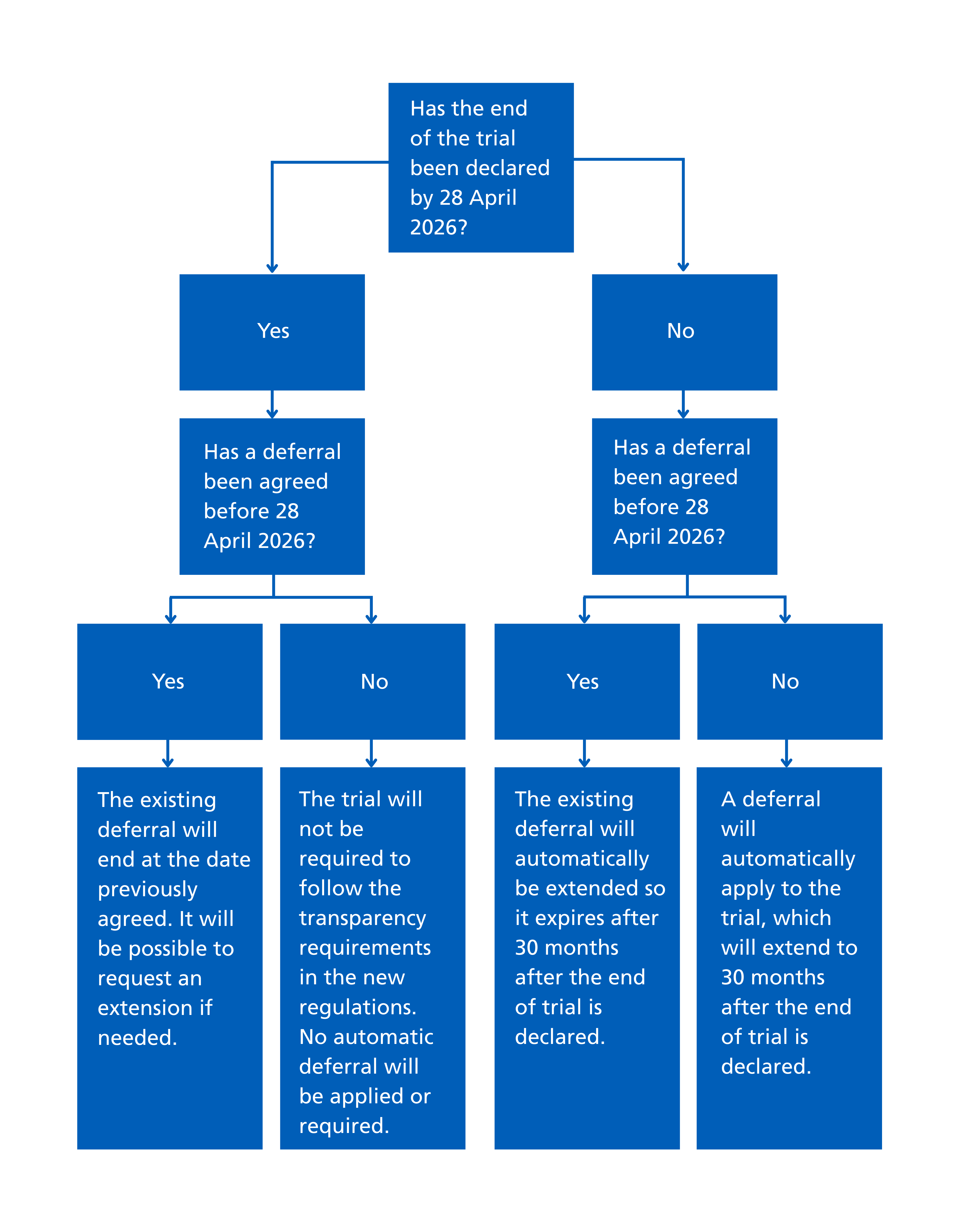
Requirements for Phase 1 trials with automatic deferrals
If a trial has an automatic deferral in place, the sponsor will not have to:
- register the trial in full until 30 months after the trial has ended, however the sponsor must still publish a minimal record on a publicly accessible registry (a minimal record can be published with ISRCTN)
- publish the summary results of the study until 30 months after the trial has ended
- offer to share results with participants during the deferral period
Where a trial qualifies for the automatic deferral, the sponsor will still need to carry out the activity in the 'requirements once a deferral is agreed' section of our deferrals guidance.
It’s still important for sponsors to thank participants or relevant people and provide them with a timeframe for receiving results, even if a deferral is in place.
Although all Phase 1 CTIMPs involving only healthy volunteers submitted from 28 April 2026 will be provided with an automatic deferral, it’s up to the sponsor to decide whether to use this deferral or not.
This means that if the sponsor chooses to register the study, publish summary results, and/or offer to share findings with participants during the automatic deferral period, they can do so.
Extending the deferral for publishing and offering to share summary results with participants beyond the automatic deferral period
We acknowledge that, for Phase 1 healthy volunteer trials, legitimate concerns around commercial confidentiality will often continue beyond the initial automatic deferral period, particularly in relation to the publication of summary results and the offer to share them with participants.
To address these concerns, the sponsor will be able to request, in the cover letter accompanying their initial clinical trial application, 2 additional consecutive 30 month deferral periods beyond the automatic deferral period to cover publication of the summary of results and offering to share results with participants.
Where a sponsor requests these extensions on the grounds of commercial confidentiality, the request will normally be granted unless there are exceptional circumstances. Sponsors will only be able to request 2 additional 30 month extensions as part of the initial clinical trial application. After the trial is approved sponsors will only be able to extend their automatic deferral by following the process for extending deferrals as outlined in our deferrals guidance.
This will mean that a sponsor of a Phase 1 healthy volunteer trial will not be required to publish the summary of results or offer to share results with participants until 90 months (7.5 years) after the end of the trial.
If the sponsor reaches the end of this 90 month period and wants to defer further, they will be able to request 1 additional 30 month extension by following the process outlined in our deferrals guidance.
Where a sponsor requests this extension on the grounds of commercial confidentiality, the request will normally be granted unless there are exceptional circumstances, for example, if the trial is no longer commercially confidential because summary results have already been made public.
In total, sponsors will be able to defer up to a maximum of 10 years from the end of the trial. After 10 years, the sponsor will have to comply with the transparency requirements.
We do not expect requests for the additional 60 month extension, or any deferral requests extending beyond 30 months after the end of the trial, to include the registration requirement, as these requests will not normally be approved except in exceptional circumstances.
Deferrals for Phase 1 CTIMPs involving patients
If a trial is a Phase 1 CTIMP involving patients it will not automatically be deferred, even if it will involve both healthy volunteers and patients. Sponsors of these trials will be able to request an initial deferral of the transparency requirements by following the process in our deferrals guidance.
Although there is no automatic deferral, sponsors of phase 1 trials involving patients will be able to request 2 additional 30 month extensions to the deferral to publish summary results and offering to share results with participants when requesting an initial deferral.
Sponsors should request this as part of their initial clinical trial application. Once a trial is approved, sponsors will normally only be able to extend their initial deferral by following the process described in our deferrals guidance.
If this is requested and agreed, the sponsor will not need to complete these activities until 90 months (7.5 years) after the end of the trial. However, we still recommend that sponsors of Phase 1 trials involving patients thank the participants for taking part in their trial and explain to participants, and any relevant people, at what point they might receive the results of the study.
Waivers for exceptional circumstances
Requesting a waiver from meeting any of the research transparency requirements in the new legislation will be possible.
If a waiver is given, the sponsor will never be required to fulfil the research transparency requirements for the trial.
This differs to a deferral which only postpones the date in which the sponsor needs to meet the transparency requirements.
A request for a waiver should only be made in exceptional circumstances, for example, for reasons of national security or national defence.
Waivers will not be given on the basis of a sponsor’s commercial confidential interests. In these cases, the sponsor should instead request a deferral.
If a sponsor is planning a trial and wants to request a waiver, they should contact deferrals@hra.nhs.uk.
The request must describe why a waiver is requested and provide information on the trial.
Any information in the waiver request that would identify a trial, or any individuals or organisations involved in it, will be kept confidential.
After receiving a request, we’ll consider the information provided, respond to discuss the request further and inform the sponsor of the decision.
Project identifiers, including the IRAS ID
The IRAS ID is the unique identifier, which is generated by IRAS when you first create a project.
The IRAS ID will be used by everyone involved in the project, whatever the type of health and social care research and the approvals required. Stakeholders across the UK have agreed to adopt the IRAS ID as the common study identifier. This will enable traceability across a whole study lifecycle, from funding through to delivery and dissemination. It will enable data sharing with organisations across the research landscape and streamline services for users. IRAS Help has more information.
All available project reference numbers should be entered into your IRAS dataset so that they may be included on your application form(s).