From 28 April 2026, changes to all approved studies will no longer be called 'amendments'.
Instead, they'll be referred to as 'modifications'. To familiarise yourself with this, we recommend you first read the 'amendments' section of our terminology guidance, which details the changes in the new clinical trials regulations.
Any substantial modification requests submitted on or from 28 April 2026 will follow the processes and timeframes introduced by the new regulations. Any substantial amendment requests submitted before this date will follow the current process and timeframes.
The following sections outline what the approval process and timeframes for substantial modification requests, which will be reviewed by the Medicines and Healthcare products Regulatory Agency (MHRA) and/or the Research Ethics Committee (REC), will be.
You may also find it useful to visit the MHRA's guidance on modifications and changes that will happen when the new regulations come into force.
The following guidance does not set out the processes and timelines for other reviews a modification to a clinical trial of investigational medicinal product (CTIMP) may need, such as HRA and Health and Care Research Wales (HCRW) Approval.
This is because only the REC and MHRA review process for CTIMPs is within the remit of the clinical trials regulations and is directly impacted by the new legislation.
If changes are made to the processes and timelines for other reviews of CTIMPs, we’ll share separate guidance and information with you.
Modification timeframe and process
Submission of substantial modification requests
To submit a substantial modification request, the sponsor will follow a process similar to the current process for submitting amendments as described in IRAS (Integrated Research Applications System) help.
They’ll first complete a 'modification tool' (currently referred to as the ‘amendment tool’) capturing the details of the trial and the changes they want to make. This will categorise the modification, identify what reviews are needed and give guidance on how to submit it.
Once the sponsor has all associated documents ready, they can submit the modification.
If a substantial modification relates to a trial submitted through Combined Review, the sponsor will continue to submit it, along with the related documents, through the new part of IRAS.
If a substantial modification relates to a pre-Combined Review trial submitted through standard IRAS, the sponsor will continue to submit it to the REC through the submission portal in IRAS and to the MHRA through the MHRA submission portal.
Substantial modification request validation
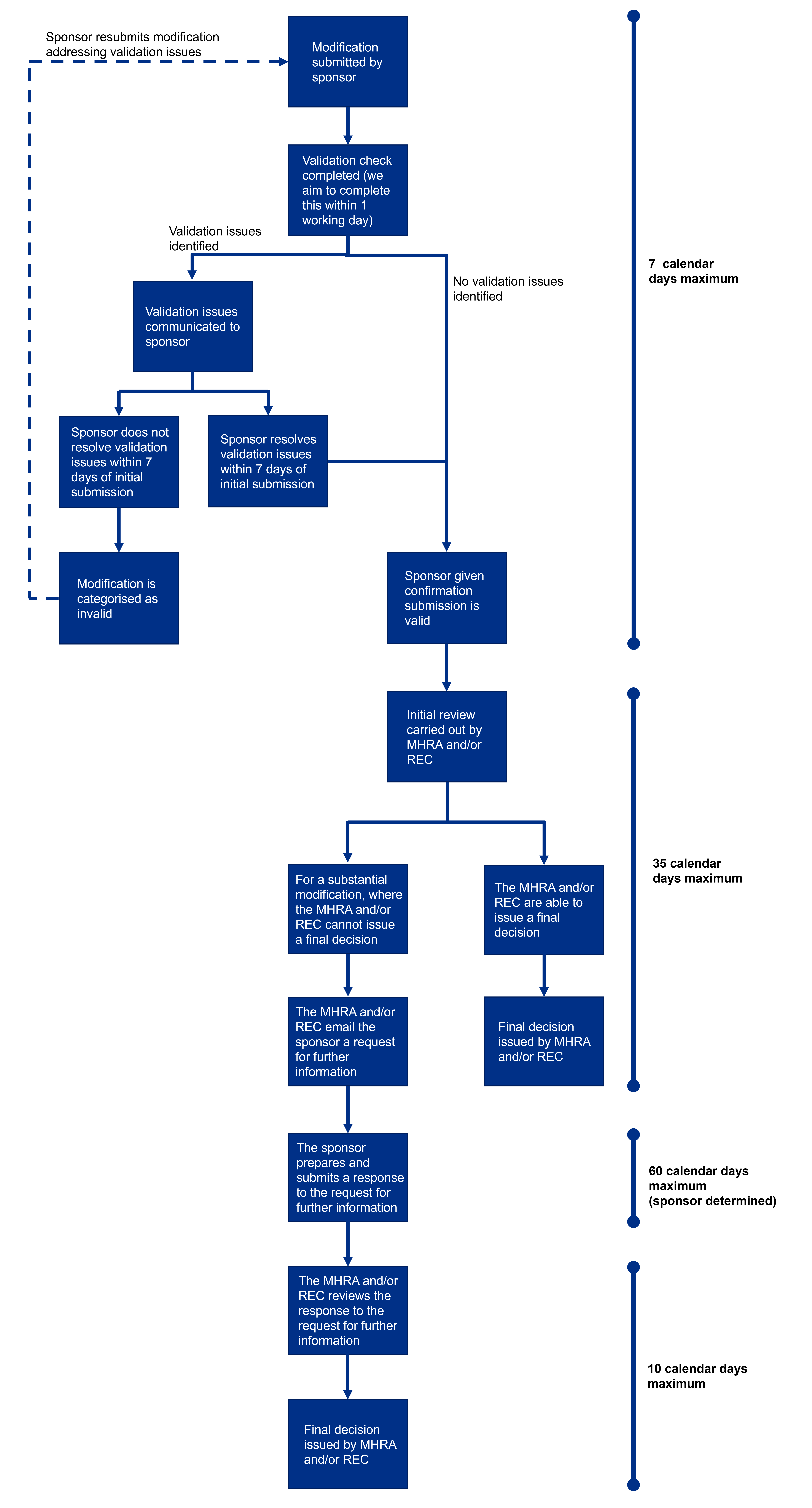
When a sponsor submits a substantial modification request, the MHRA or REC will check to make sure it’s valid. We’ll aim to communicate the outcome of the validation check within 1 working day of it being submitted.
If the REC or MHRA identify any issues that prevent a substantial modification request from being considered valid, the sponsor will be asked to address these issues within 7 calendar days of when they submitted the substantial modification request.
If they cannot address these issues within 7 days, the MHRA and/or REC will categorise the substantial modification request as invalid. This means the sponsor will need to resubmit the substantial modification request, making sure they address the validation issues raised by the MHRA and/or REC.
In all cases a substantial modification request will either be confirmed as valid or invalid within 7 calendar days of the modification being submitted. The sponsor will be notified via email to confirm if the substantial modification request is valid or invalid.
Once a substantial modification request is confirmed as valid, it will be reviewed and an outcome will be issued within 35 calendar days.
Initial review outcomes
There are 3 possible outcomes from the initial REC review of a substantial modification request, these are:
- favourable opinion
- favourable opinion subject to conditions
- unable to issue a favourable opinion and requests further information
If the substantial modification is relevant to both the REC and MHRA, the REC opinion and the MHRA decision together will form the outcome of the initial review of a substantial modification request.
If the REC and the MHRA are unable to approve the trial at this stage, a request for further information will be issued. This may be from the REC, the MHRA or both.
Requests for further information
The new clinical trials regulations will allow the MHRA and REC to request further information when considering substantial modification requests.
This means that if the MHRA or REC identify issues that prevent a substantial modification request from being approved, the sponsor will be informed of these issues and will be able to respond before a final decision or opinion is issued. Requests for further information for substantial modifications will only be issued in a minority of cases, where it’s not possible for the REC to give a favourable opinion or a favourable opinion with conditions.
If a request for further information is required, it will be sent within 35 calendar days of the substantial modification request being confirmed as valid. If a sponsor receives a request for further information, they’ll have a maximum of 60 calendar days to respond. A sponsor can respond at any point within the 60 day timeframe. If they do not respond within 60 days, the substantial modification request will not be authorised by the MHRA and will be given an unfavourable opinion by the REC.
If the sponsor needs longer to prepare a response to the request for further information, they can request an extension.
They can ask for this by emailing the MHRA at clintrialhelpline@mhra.gov.uk or, if the request for further information only relates to the REC review of a substantial modification request, by contacting the REC directly. They will need to explain in their request why they need an extension and when they expect to respond. If an extension is agreed, the REC and MHRA will make each other aware.
MHRA and REC reviewing a response to a request for further information
Once the sponsor submits a response to a request for further information, the MHRA and/or REC will decide the outcome within a maximum of 10 calendar days. This will be communicated via email, or through IRAS if the substantial modification relates to a trial that was initially submitted through Combined Review.
There are three possible outcomes from the REC after they review a response to request for further information these are:
- favourable opinion
- favourable opinion subject to conditions
- unfavourable opinion
If a substantial modification request is given an unfavourable opinion, the sponsor can appeal by emailing us at appeals@hra.nhs.uk within 28 calendar days of receiving the outcome. The sponsor will need to outline why they disagree with the outcome issued for the modification when they submit their appeal.
Submitting concurrent substantial modifications
If a sponsor has already submitted one modification request that is undergoing review and they want to submit another modification, they can do this in certain circumstances.
Multiple modifications can be submitted if they are changes to the project information and there is no overlap between the modifications. For example, a sponsor can submit 2 modifications to the project information for a trial at the same time as long as the modification does not involve changes to the same study documents or responses to the same question set in IRAS.