Introduction
The HRA is part of the health and social care research sector that is focused on improving everyone’s health and wellbeing.
Our vision is for high-quality health and social care research today, which improves everyone’s health and wellbeing tomorrow.
Our mission in support of this vision is to make it easier to do research that people can trust.
This is important because research findings can improve everybody’s care faster if more health and social care research is taking place that a wider diversity of people are confident and able to take part in it. Getting this right will improve the health and wellbeing of everybody in the UK and contribute to economic growth.
Established in 2011, we have transformed UK research regulation and governance by simplifying processes, removing duplication, and reducing timelines. We have better supported the research community by putting people first.
About us
The Health Research Authority (HRA) is an independent arm’s length body of the Department of Health and Social Care (DHSC). We have up to 300 staff in England who work at home and in our four offices. Our staff are supported by a community of almost 1,000 people who volunteer their time generously to help us deliver our services, alongside NHS staff and members of the public who advise us on our work.
The HRA is led by a Board, Chaired by Neelam Patel which includes our Chief Executive, Matt Westmore, two executive directors and up to four non-executive directors. The Board has strategic oversight, agreeing high-level policy and ensuring that the HRA is run effectively and efficiently. Find out more about our leadership.
We are one of many organisations that work together in the UK to regulate different aspects of health and social care research. The HRA delivers some of the approvals that health and care research requires to ensure it is safe, well designed and meets UK ethical standards of doing no harm. It coordinates and standardises these expectations UK-wide and runs the UK’s online system to get all these approvals, making it a unique enabler of all health and care research, ensuring it is fast and simple.
The UK government has set out five missions as part of its plan for change. Our work directly supports the missions for health and growth. At the heart of our work are people. People who could benefit from research findings improving their care, helping them to have a better quality of life and play a more active role in society.
The UK’s health mission sets out to address the main underlying drivers of ill-health and tackle persistent inequalities in health to put the NHS on a more sustainable footing for the future. Research will be key to doing this well. Research that has been done with and for everyone so that the whole population can benefit from its findings will do this best. That is why our work to ensure that research is done in a way that people can trust, including everyone, is important to build a health service fit for the future.
The UK is a great place to do high quality health and social care research – with a diverse population, strong science base and national health service. Attracting more research to happen here will benefit both people in the UK and help grow our economy. That is why our work to make it easier to do research is important to the government’s mission to kickstart the UK’s economic growth.
Our role
Our aim is for research findings to improve care faster because the UK is the easiest place in the world to do research that people can trust. To do this, we:
- work with people to understand what you want research to look like and act on this so that you can trust research
- make sure that people taking part in research are treated ethically and fairly, by reviewing and approving health and social care research studies that involve people, their tissue or their data before they can start as part of a UK-wide regulatory service
- champion research transparency, so that you can always see when research is taking place, or the results of that research if it has finished
- work with other organisations across the UK to reduce the burden, cost and time to set up research, meaning that wherever you are, research studies can be set up smoothly and are always subject to the same scrutiny before they start. This includes running streamlined digital services and a UK-wide partnership to help plan, apply for, approve, set-up, manage and complete research in the UK.
- are one of the gatekeepers of patient data, making sure that your information is used in ways that you can trust
Our strategy: boosting research that improves health and grows the economy
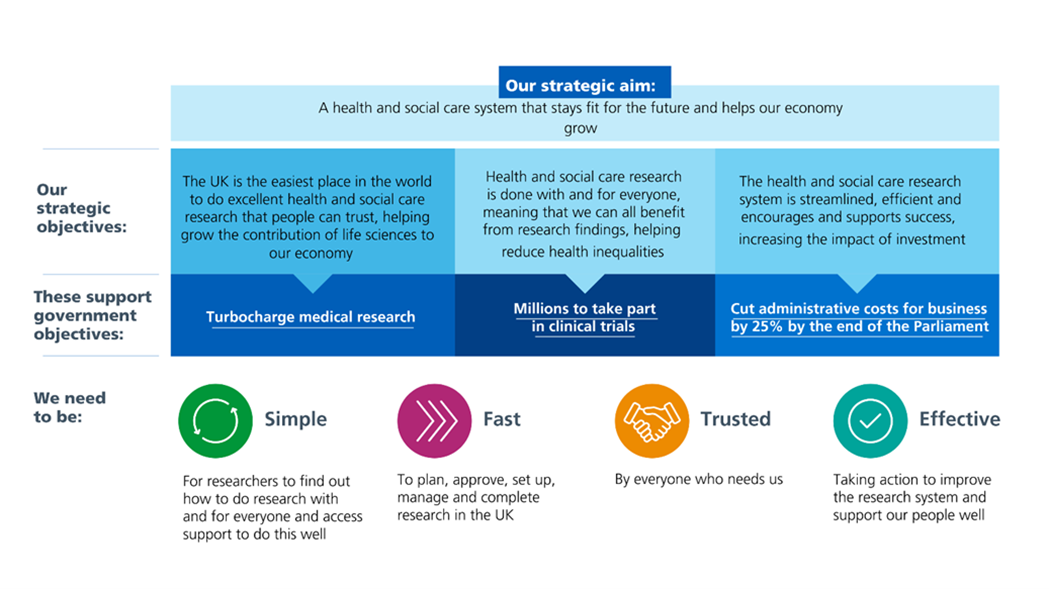
More information on our strategy and how we work in partnership to make it easy to plan, support, manage and complete health and social care research in the UK is detailed in our strategy 2025-28.
UK government objectives that we support
We are committed to delivering on government priorities as part of our strategy and business plan development. This includes the UK government's Plan for Change, the 10-year health plan for England and the UK's Modern Industrial Strategy.
Strategic objective
The UK is the easiest place in the world to do excellent health and social care research that people can trust, helping grow the contribution of life sciences to our economy.
Key results
- the time it takes to get a clinical trial set up in the UK will be cut to 150 days by March 2026 (PM commitment), whilst this commitment has been achieved it remains an area of continuous improvement.
- creating a faster, more efficient, more accessible and more innovative clinical research delivery system – making the UK a world leader in clinical trials (UKCRD mission)
- 99 percent of UK studies receive a combined review decision within 60-days (UKCRD metric)
- 90 percent of studies open to recruitment within 60 days of HRA approval letter or equivalent process used by the Devolved Administrations. (UKCRD metric)
Strategic objective
Health and social care research is done with and for everyone, meaning that we can all benefit from research findings, helping reduce health inequalities
Key results
- more people are confident to take part in health and social care research bring the benefits of clinical trials to everyone
- increase in UK adults that say they would take part in research if asked. (baseline from HRA public attitude polling in 2023 (68 percent of UK adults would take part in health and social care research if asked).
- increase in UK adults that are confident that they would be treated with dignity and respect if they took part in research. (baseline from HRA public attitude polling in 2023- 75 percent of people are confident that they would be treated with dignity and respect if they took part in research)
- increase in public confidence in access to healthcare data for research (supporting the health data research service)
- increase in people registered with Be Part of Research
Strategic objective
The health and social care research system is streamlined, efficient and encourages and supports success, increasing the impact of investment
Key results
- cut administrative costs for business by 25 percent by the end of the Parliament. New approach to ensure regulators and regulation support growth
- meet commitment for government departments to reduce their administrative budgets by 15 percent by the end of the decade Spring statement 2025
- support a thriving domestic AI ecosystem, with serious players at multiple layers of the “AI stack” and widespread use of AI products and services across the economy. AI opportunities plan
- we are a digital service to be proud of A blueprint for modern digital government
Our priorities for 2026-27
In this section we'll look at our key priorities for 2026-27.
Simple: for researchers to find out how to do research with and for everyone and access support to do this well
Strategic outcome: make it easier to do research across different settings in the UK, broadening access to research
We will focus on finding solutions to delays experienced across research sites, removing barriers and communicating the best way to set-up research. This includes standardising services across nations; streamlining the set-up process for different research settings and developing proportionate approaches to managing research.
Strategic outcome: researchers have a positive experience when finding out about what they need to do and earning the approvals that they need
We will provide our approvals services including ethics review, HRA approval and decisions on the use of confidential patient information without consent in England and Wales where 75% of applicants rate our overall service highly.
Strategic outcome: make research more transparent
We plan to review our ‘Make it Public’ strategy, using data and appropriate engagement and involvement to inform our refresh, which will set out our priorities for promoting research transparency going forward.
Strategic outcome: ensure that more research meaningfully involves the public to inform the way it is done
We will continue to enable the Shared Commitment to Public Involvement and we plan to publish a paper on the impact of public involvement in research to support recognition of its value throughout the research and innovation system.
Strategic outcome: support greater representation in, and access to, research so that people from all backgrounds across the UK can take part in research relevant to them
The findings from the Inclusion and Diversity Plan pilot will be used to support decision making on the next steps. We will also convene the UK Clinical Research Inclusion Group to facilitate cross-sector activities to enable greater inclusivity and participant representation in clinical research.
Strategic outcome: support researchers to do research in new ways and using new technologies such as AI to improve care in a way that people can trust
We will publish an AI plan in May 2026, setting out three areas of work that we will focus on over the next two years. We will review and refresh this plan alongside our next strategy.
Fast: to plan, approve, set up, manage and complete research in the UK
Strategic outcome: provide approvals in time to support the set up of clinical trials in 150 days
We are focused on continuously reducing the average and maximum time it takes for researchers to earn the approvals that they need for their research to go ahead.
We will also we put in place operational changes to meet new clinical trials regulations (CT Regs) requirements including adjustments to timeline monitoring, testing new approaches to reviewing responses to requests for further information to continue to streamline and make improvements to our services.
Strategic outcome: make setting up research more efficient, with simple steps and no duplication
We will focus on developing the ideal path to set-up studies (most efficient with no duplicative steps) and making sure this is embedded in our digital services.
We will also look to grow the value in the system created by standardised, centralised processes, for example technical assurances and information governance, removing duplication by increasing adoption, growing capacity and seeking opportunities to grow study-wide services.
Strategic outcome: make it faster and easier to use our new digital services to plan, approve, set up, manage and complete research in the UK
We will continue to deliver our Research Systems programme (RSP) transforming the UK’s clinical research approvals system, increasing the number of modifications flowing through the system and gaining 75% satisfaction with the new services.
Trusted: by everyone who needs us
Strategic outcome: ensure that our digital services are secure
We will monitor our security score and make sure it meets a minimum of 60% and audit our cyber security and information governance systems in line with national guidance and take action to address findings as required.
Strategic outcome: ensure that people can understand, value and trust us and the way that we work
We will agree how stakeholder perceptions need to change to support delivery of our strategy, informed by 2025-26 persona work and develop a communications and engagement strategy to define channels, content and campaigns.
We will hold our first Board engagement activity in 2026 to embed more diverse perspectives and expand our demographic monitoring to everyone we work with to track involvement diversity. We will also run a campaign in 2026 to increase under-30 participation in RECs and agree how we measure this improvement.
Strategic outcome: ensure that our assurances are understood, valued and trusted, not unnecessarily repeated to set up research
We will use data including sentiment analysis, stakeholder engagement and audience development to identify opportunities and best tactics to take action to increase trust in our assurances.
Strategic outcome: ensure that people know when and how to raise questions and concerns with us and we are clear how we will act on them
Informed by our work to better know who needs us, what they need and why, we will make it easier to understand our role, including how to raise questions and concerns with us.
We will raise awareness that people can make complaints in a range of ways that suits them and meet their needs.
Effective: taking action to improve the research system and support our people well
Strategic outcome: develop safe, scalable and secure digital infrastructure
We will put in place an Azure Landing Zone (ALZ) aligned to Microsoft best practice and designed for high availability, resilience and robust disaster recovery.
Strategic outcome: use AI
We will grow the use of Microsoft Copilot to automate basic processes and streamline workflows and develop 2-3 AI proof of concepts to streamline research approvals and improve timelines.
Strategic outcome: ensure that our staff have a high level of engagement
We will implement strategies to:
- build a confident, adaptable workforce
- strengthen organisational inclusion
- improve leadership and management capability
- comply with new legislation
- understand strategic workforce requirements
- provide high-quality People services
- put in place a coherent, supportive and accessible learning experience
Strategic outcome: ensure that our community of volunteers and public contributors have a good experience with us and can see the difference they make
We will act on the findings of the HRA community survey 2026 including
- implementing change campaigns to support REC members as improvements and adjustments are put in place responding to CT Regs and RSP requirements
- tailored recruitment campaigns for new members
- plans to make sure everyone is treated fairly and consistently
Strategic outcome: play our part in reducing government running costs
Our key focus will be to develop a greater understanding of our target operating model as a blueprint for how we deliver value to patients, the public and the research sector. It will set out how we expect the HRA to work as an integrated system, focusing on the outcomes we want to achieve and the capabilities required to deliver them. In addition we will set out three measurable outcomes to evidence our commitment to this priority
Health and social care system: strategic priorities
Strategic priority: implement new clinical trials legislation and continue to take action to make it more proportionate for researchers to navigate the regulatory process without reducing rigour.
We will create and put in place enabling activities to support the research community to use the new regulations.
We will make sure we encourage feedback throughout to learn from the research community and continue to develop our enabling activities to meet their needs.
Strategic priority: ensure our processes are aligned with the wider work to help public health researchers find out what they need to do and earn these approvals.
We will continue to engage with policy leads, funders and partners to make sure we are joined up in our advice to researchers about earning approvals.
Strategic priority: Work with others so that social care researchers can find out what they need to do and access support available to them to earn approvals.
With our partners in the Devolved Administrations, we will put in place changes set out in the UK REC policy concerning social care research funded by DHSC and NIHR.
Strategic priority: ensure that our policies and practices support international collaboration with UK researchers, and enable the UK to be a global partner in promoting safe and ethical research.
Our work will focus on ensuring our policies and procedures enable international collaboration through continuous improvement activities within our approvals services, policy and partnership activities.
Strategic priority: Provide information and resources to support wider work to demonstrate the attractiveness of the UK.
We will use our increased understanding of our stakeholders to produce content and develop our channels to better show what we do, how well we perform and the contribution this makes to the UK health and social care research environment.
Strategic priority: Work in partnership to support new ways to do research such as working alongside the Health Data Research Service and make sure that regulation keeps up with research so you trust our decisions.
We will make sure our regulatory approach remains consistent and proportionate as new data-enabled and AI-enabled research models emerge. We will also focus on providing clear guidance, approvals and information governance advice, alongside policy and stakeholder engagement to make sure alignment with national partners.
Key metrics for 2026-27
| Measure | 2026-27 |
| People tell us that it is easy to set up studies in the UK including across NHS and non-NHS settings | Improve by 3% on baseline data (2025-26 survey) |
| Applicants who rate our overall service highly | 75% |
| Applicants who rate our new digital services highly | 75% |
| Registration of clinical trials | Improve on 94% |
| Clinical trials sharing their results with participants | Improve on 52% |
| Increase in rates of public involvement in applications for review by a Research Ethics Committee | Improve on 84% (2024 data) |
| Provide approvals of clinical trials within a maximum of 60 days, with a median timeline below 40 days | 100% |
|
Provide a decision on support for the use of confidential patient information without consent in England and Wales from the Confidentiality Advisory Group within 60 days or where a precedent has been supported within 30 days |
100% |
| Research applications receive a HRA and HCRW Approval decision in less than 60 days | 100% |
| Increase in sponsor uptake of technical assurances for eligible studies | Improve by 5% |
| Maintain security score for our digital systems | 60% |
| Meaningfully involve people with the HRA’s work where people rate that they had shaped and informed the work they had been involved in | 80% |
|
Complaints completed in 25 days and no more than 5% resulting in a subsequent appeal to the Chief Executive |
100% |
| Maintain and grow our high level of staff engagement | Improve on 74% (2025 survey) |
| Maintain our HRA community satisfactions levels | 80% |
| Make sure forecast and out-turn expenditure is within 4% of funding | 4% |
Financial plan
Our financial plan for 2026-27.
Our total funding anticipated for this year is £33.8M (2025-26: £33.3M). We receive most of this directly from the Department of Health and Social Care. In 2026-27 this funding, known as grant-in-aid (GIA), will be £22.1M (2025-26: £20.8M) to fund revenue activities, £10.0M (2025-26: £11.0M) to fund capital investment and £1.0M (2025-26: £1.1M) to fund non-cash revenue (for example, depreciation).
The rest of our revenue comes from the devolved administrations (£0.6M) as part of cost sharing arrangements for ethics review and UK wide research governance (2025-26: £0.6M). The HRA is committed to providing value to the public purse. We achieve this in two ways:
- streamlining the research set-up process, driving economies and efficiencies to the research sector
- achieving ‘more for less’ in our services and policy work, by continuously improving our processes, reducing duplication and using technology to add value and reduce costs.
We have planned for a balanced income and expenditure position for 2026-27 on our core services and change activities. This is enabled by £1.5M recurrent efficiencies and savings achieved during 2024-25, to manage inflationary pressures and increased investment in transforming our digital services. The financial plan table sets out our sources of revenue funds for 2026-27. It also shows how these compare with our 2025-26 financial plan.
Capital funding
Capital funding of £10.0M (2025-26: £11.0M). This funding supports our essential digital services transformation as well as core infrastructure (estates and technology). Capital funding has been confirmed by DHSC. The following table shows how capital funding will be invested.
| 2026-27 | 2025-26 | |
| £000 | £000 | |
| Digital services transformation | 9,900 | 10,900 |
| Core infrastructure (estates and technology) | 100 | 100 |
| Total capital expenditure | 10,000 | 11,000 |
Research digital services transformation
Our research digital services transformation programme gained approval from DHSC Investment Committee in 2023. A change request for this programme was considered and approved by the Committee in February 2025. Funding and activity related to this programme are included within this business plan for 2026-27 based on our most up to date programme roadmap. Spending Review 2025 has confirmed this programme is funded for the period of the review.
Financial plan 2026-27
| 2026-27 | 2025-26 | |||||
| Pay £000 | Non Pay £000 | Total £000 | Pay £000 | Non Pay £000 | Total £000 | |
| Regulatory Services | ||||||
|
Integrated approval service |
7,684 | 294 | 7,978 | 6,699 | 324 | 7,023 |
|
Confidentiality advice service |
222 | 32 | 254 | 202 | 39 | 241 |
|
Guidance and learning |
75 | 71 | 146 | 330 | 135 | 465 |
|
Quality assurance |
150 | 5 | 155 | 152 | 18 | 170 |
| Approvals support | 515 | 361 | 876 | 497 | 363 | 818 |
|
Innovation and improvement |
633 | 14 | 626 | 500 | 18 | 518 |
| 9,258 | 777 | 10,035 | 8,380 | 897 | 9,277 | |
|
Strategy, governance, and policy |
||||||
|
Corporate governance & chief executive |
944 | 148 | 1,092 | 869 | 38 | 907 |
|
Policy and engagement |
917 | 132 | 1,049 | 937 | 83 | 1,020 |
| Communications | 433 | 25 | 458 | 413 | 62 | 475 |
|
Public involvement |
222 | 21 | 243 | 204 | 42 | 246 |
|
Artificial intelligence and data services |
71 | 271 | 342 | 50 | 5 | 55 |
|
Strategic activities |
0 | 0 | 0 | 0 | 76 | 76 |
| 2,587 | 598 | 3,185 | 2,472 | 239 | 2,779 | |
| Digital | ||||||
| Research systems | 3,499 | 2,481 | 5,980 | 2,500 | 2,966 | 5,466 |
| Infrastructure | 200 | 300 | 500 | 191 | 302 | 492 |
| 3,699 | 2,781 | 6,480 | 2,691 | 3,268 | 5,958 | |
| Corporate functions | ||||||
|
Corporate portfolio office |
416 | 11 | 427 | 393 | 14 | 408 |
|
People, diversity, inclusion and learning |
638 | 415 | 1,053 | 600 | 358 | 958 |
|
Finance, commercial & estates |
844 | 424 | 1,267 | 809 | 389 | 1198 |
| 1,897 | 850 | 2,747 | 1,803 | 762 | 2,564 | |
|
Total before depreciation and efficiency |
17,441 | 5,006 | 22,447 | 15,345 | 5,166 | 20,579 |
|
Business change costs |
0 | 100 | 100 | 0 | 100 | 100 |
|
Inflationary pressures and strategic reserves |
0 | 210 | 210 | 400 | 257 | 657 |
| Total (before depreciation) | 17,441 | 5,316 | 22,757 | 15,745 | 5,523 | 21,336 |
| Depreciation | 0 | 1,000 | 1,000 | 0 | 1,000 | 1,000 |
| Total (after depreciation) | 17,441 | 6,316 | 23,757 | 15,745 | 6,523 | 22,336 |
| Funded by | 2026-27 | 2025-26 |
| £000 | £000 | |
|
DHSC revenue grant in aid |
22,081 | 20,793 |
|
Non-cash DHSC revenue (unconfirmed) |
1,000 | 1,000 |
|
Other income (unconfirmed) |
676 | 543 |
| Total | 23,757 | 22,336 |