Matt Westmore, Chief Executive
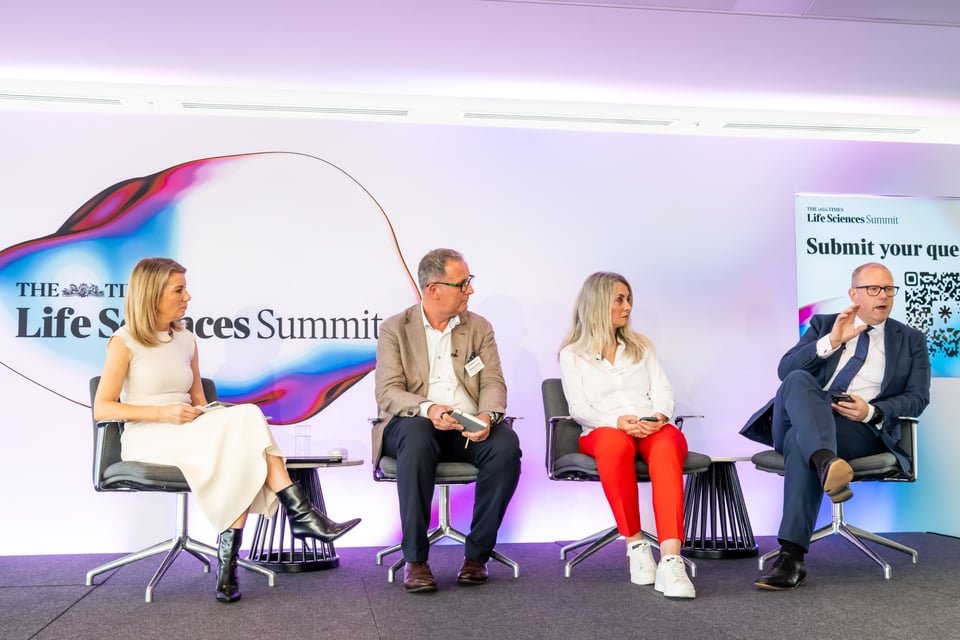
Last week I joined a panel at The Times Life Sciences Summit, a gathering of around 200 senior leaders from industry, the NHS, government and investment. The mood was strikingly positive - confident in the UK’s strengths, while clear that we face growing global competition, particularly on investment and scaling innovation.
The panel was chaired by Times Radio presenter Kait Borsay. Other panel members were Robert Evans, CEO of Wellcome Genome Campus, and Dr Doina Ionescu, General Manager for Healthcare UK&I at Merck.
We were focused on a simple question: how do we make the UK the most attractive place in the world to develop and deliver new treatments?
To me, the answer starts with something equally simple: You should not have to make sense of the system. The system should just make sense.
An attractive life sciences environment is one where innovators can rely on end-to-end predictability - clear and proportionate regulation, rapid set-up, reliable recruitment, and swift adoption into care.
In terms of life science research and innovation, the UK already has exceptional strengths.
Organisations such as the Health Research Authority, the Medicines and Healthcare products Regulatory Agency, the National Institute for Health and Care Excellence, the National Institute for Health and Care Research and UK Research and Innovation all play a significant role.
These sit alongside a comprehensive NHS with a diverse patient population, an outstanding science base supported by a unique blend of charity, public and industry funding, and strong political backing.
We also have unparalleled - if not yet fully realised - data assets, with lots of excitement about the new Health Data Research Service coming throughout the day.
And these strengths translate into outcomes. Regulatory timelines are faster and more consistent than ever, with an average ethics review time of 29 days for clinical trials of investigational medicinal products (CTIMPs) and all clinical trials of medicines reviewed by HRA and MHRA within the 60-day target. We are now setting up studies in an average of 122 days, meeting the Prime Minister’s ambition to get clinical trials up and running within 150 days.
We remain a top 10 global destination for clinical trials across all phases. Commercial clinical trial applications rose by 5.1% last year, user satisfaction with the approvals system exceeds 90%, and the sector contributes more than £17bn to the economy while supporting around 300,000 jobs. Fourteen of the top 100 universities in the world for life sciences are found in the UK.
We should be proud of that. But it isn’t enough.
Because global investment decisions are not made based on how strong individual parts of a system are - they are made based on how well the system works as a whole.
And right now, that experience is not consistently seamless.
Research is inherently complex. It involves multiple steps and organisations from initial idea through to patient benefit. But that complexity should not be visible to those who use the system. Our job is to hide the wiring.
The user - whether a patient wanting to take part in research, or a company looking to invest - should not have to navigate fragmentation, duplication or unclear ownership. The system should feel simple, coherent and predictable.
Today, that is not always the case. The journey can feel disjointed, with duplication and complex handovers. We improve things, but not always in a tightly coordinated way or with full visibility of the system-wide impact. We don’t always think with one mind or speak with one voice.
If we want to remain globally competitive, we need to do more than refine what we already have. Other countries are improving incrementally. To stay ahead, we need to be willing to think more radically about how the system operates.
A more joined-up model is the next step for the approval, setup and delivery of research in the UK. This should be focussed on reducing fragmentation and duplication, creating a clearer front door for innovators, and making the system easier to navigate.
That means being clear about accountability. It is my personal view that for every step in the research pathway, one and only one organisation should be responsible for reviewing, deciding, and providing assurance for the whole system. No duplication. No double-checking.
We are seeing the benefits of this approach in research ethics. In the UK, one ethics opinion applies across all sites and all four nations. In many other countries, approvals are still required in multiple places. That simplicity has been a competitive advantage for more than a decade. But others are catching up.
If we extend that same principle - one review, done once, applied everywhere - across the entire research pathway, we have the opportunity to transform the system and sustain the UK’s global leadership.
Because in the end, excellence is not just about what each part of the system does.
It’s about how the system feels to the people who rely on it. And that should feel simple.