This report provides an overview of the activity of the 64 Research Ethics Committees (RECs) in England from 1 April 2024 to 31 March 2025. The report also details the activities undertaken by the approvals directorate to support and develop RECs and streamline application reviews during the reporting period.
This report enables the HRA Board to monitor the performance of the RECs in England as detailed in the Governance Arrangements for Research Ethics Committees (GAfREC).
Out of the 64 RECs, the UK Ethics Committee Authority (UKECA) recognises 45 RECs to review Clinical Trials of Investigational Medicinal Products (CTIMPs), and 19 RECs are authorised in line with GAfREC to review all other health and social care research (excluding CTIMPs).
RECs are allocated flags for specialist areas of research to recognise relevant professional, academic and ethics expertise among the REC membership, including expertise acquired through training or previous experience in the relevant field of research ethics. The flags focus on research involving:
- adults lacking capacity to give consent
- adult social care
- children
- gene therapy
- medical devices
- prisoners in England and Wales or otherwise conducted in His Majesty’s Prison and Probation Service (HMPPS)
- qualitative research
- research databases
- research tissue banks
Key highlights
The year 2024-2025 has been a positive one which saw a number of achievements. Below are the key highlights mapped specifically against the pillars of the HRA Strategy for 2024-2025:
Accelerate
Research findings improve care faster because the UK is the easiest place in the world to do research that people can trust.
The approvals directorate continually monitors the booking and review of health and social care research applications, to ensure that the Research Ethics Service is responsive to business need and can deliver an ethics opinion in a timely manner, whilst maintaining a high standard of ethics review. Below are just a few highlights as to how the approvals directorate worked with REC chairs and members to ensure a responsive Research Ethics Service.
Seasonal RECs
Seasonal RECs are ad hoc committees, made up of experienced REC members from across the Research Ethics Service. The purpose of these RECs is to provide additional capacity in the service to review new full REC application submissions at peak times in spring, summer and winter holiday periods. This allows the service to adapt flexibly to an influx of CTIMP applications around these times.
Between 1 April 2024 and 31 March 2025, the Seasonal RECs held 7 REC meetings, which were in addition to the 638 full REC meetings established to review health and social care research applications. The Seasonal RECs reviewed 28 CTIMP applications and the median time to issue a final opinion (excluding the period awaiting a response to further information or provisional opinion) was 29 days.
Gene therapy and stem cell clinical trials
Gene therapy and Advanced Therapy Medicinal Product (ATMP) applications have increased year on year highlighting the need to provide additional application booking slots. A proposal to flag 2 more RECs, Brent and Berkshire B RECs, in addition to the 3 RECs already flagged to review gene therapy and ATIMP applications was approved by the UK Ethics Committee Authority (UKECA) in June 2024.
To prepare for this flag, the members of Brent and Berkshire B RECs received relevant training and were provided the opportunity to observe the review of gene therapy applications by an existing gene therapy flagged REC.
By the end of the reporting period, the Brent and Berkshire B RECs had reviewed 4 gene therapy and ATIMP applications. The median timeline for a gene therapy CTIMP during the reporting period was 33.5 days compared with 52 days in 2023/2024.
Proportionate review
In April 2024, several changes were made to the proportionate review process. These changes included more responsibility for applicants when determining suitability for proportionate review, which allowed the approvals directorate to introduce a streamlined screening process and making the Approval Specialist the default to review a response to a Provisional Opinion. These changes demonstrated some benefits to timelines, but also by increasing the number of applications reviewed at a proportionate review sub-committee the approvals directorate reduced the number of applications reviewed at full REC meetings. The reduction in applications at full meetings provided RECs more time to focus on ethical issues. The review of responses to provisional opinions by the Approvals Specialist has also reduced the burden on REC Chairs.
REC application bookings
To ensure that service meets demand for applications as much as possible, and to ensure workload was more uniform across RECs, a pilot was undertaken in summer of 2023. This pilot looked at the impact of the reduced screening process by HRA staff for applications deemed suitable for proportionate review by researchers and considered the impact on decision rates as well as the number of slots needed at both full REC meetings and proportionate review sub-committee meetings. Following this and taking into consideration the change to how Proportionate Review applications would flow through the system, the number of REC slots were standardised at both full REC and proportionate review sub-committee meetings for RECs in England from April 2024.
After considering application volumes and the changes made to the screening for suitability of proportionate review applications, it was agreed that recognised RECs would review four applications at a full REC meeting and two applications at a proportionate review sub-committee meeting. Authorised RECs would review 3 applications at a full REC meeting and 3 applications at a proportionate review sub-committee meeting. Thus, the application meeting slots were amended to meet business need but also provided RECs with more time to focus on ethical issues.
Feedback about this change from REC Chairs at the twice-yearly regional Chairs meetings has been positive, with the workload across RECs also becoming more consistent.
Include
Health and social care research is done with and for everyone.
REC development days 2024-25
REC development days are just one of the ways the approvals directorate enables RECs to come together to hear and ask about important updates from the HRA and other partners, to receive training on a relevant topic and to develop as a REC team.
During 2024-2025 4 face to face REC development days and 1 online REC development event took place. Over 450 REC members attended these events.
The programme focused on the importance of considering equity, diversity and inclusion in the review of applications, along with practical guidance when reviewing proportionate review applications and serious breaches.
Feedback was received from a total of 144 members (32%) who had attended the events. This was positive, with 82% of respondents agreeing that the programme reflected the right balance between formal talks and discussion, and 98% requesting a REC development day for 2025-2026.
Below are some quotes from REC members who attended a face-to-face REC development day:
“It was lovely to meet up with fellow members of our committee and putting faces to names of staff supporting the event”.
“I really value these days and think they are very worth-while. Thank you!”
Inclusion and diversity guidance
REC members took part in the consultation on the draft inclusion and diversity guidance produced by the HRA and the Medicines and Healthcare Products Regulatory Agency (MHRA). The Research Ethics Service then piloted the guidance.
The guidance aims to help researchers to improve the diversity of participants in their research. The aim is to ensure that clinical research can improve the health of the whole population.
Shared Ethical Debate – The use of interpreters and translators in health and social care research
Shared Ethical Debate is an exercise that the approvals directorate, with the support of the quality and assurance team, conducts annually to address current ethical issues and dilemmas experienced by RECs. A report summarising each exercise and the results is produced to provide guidance and promote consistency in approach across RECs.
The Shared Ethical Debate for 2024-2025 focused on using translators in health and social care research and was created by the approvals directorate with support from the policy and engagement team and REC members. A total of 238 REC members participated in the Shared Ethical Debate and the results are currently being analysed with a view to a report being disseminated in 2025-26.
REC meeting observations
Part of the Think Ethics programme was to raise awareness of the role and function of RECs, and to engage with the public to offer opportunities for them to observe REC meetings. With the support of the policy and engagement team, the approvals directorate has reached out to members of the public via the public involvement newsletter to invite them to observe a REC meeting.
During the reporting period, we received 706 requests to observe a REC meeting; 596 of the requests came from people with an interest in research or who currently work in research, and 110 requests came from members of the public. The approvals directorate continues to support this work and streamline its processes to accommodate this increase in workload and to make observing a REC meeting even easier.
The approvals directorate also reinstated visits to REC meetings for our Executive Committee members. A member of the HRA Executive Committee will visit each REC every 3 years to gain an insight into what our volunteers do as part of their role as a REC member, and to understand the experience that research applicants have of applying for an ethics review.
During the reporting period, 29 of these visits took place, 16 are scheduled to take place later in the year and the remaining 19 are scheduled for 2026. By the end of 2026 all 64 RECs will have been visited by a member of the Executive Committee.
REC membership
Requirements
In line with the Governance Arrangements for Research Ethics Committees (GAfREC), RECs normally have no more than 18 members in total with 15 members set as an operational target.
REC membership consists of expert, lay and lay plus members. Below is the definition of each classification:
- expert members – registered healthcare professionals, retired medical doctors, clinical trials statisticians and other experts in clinical research
- lay members – retired healthcare professionals (excluding retired doctors) and current or retired members of health service bodies. Lay members exclude those whose primary professional interest is in clinical research
- lay plus members – members of the public who have never worked in health and social care/research and have never been a member of a health service body
Within each REC, at least one third of REC members must be lay, and for recognised RECs, at least half of the lay membership must be lay plus.
REC membership 2024/2025
The below figures show REC membership over the reporting period. The vacancy rate is based on each REC having 15 REC members i.e., a total of 960 members across the REC service which is an administrative target. Despite a slight dip in REC membership in February 2025 due to a temporary pause in recruitment, REC membership has remained stable due to the vast recruitment activity undertaken by the approvals directorate. During the 12-month period, the directorate processed 311 applications to become a REC member (153 expert, 64 lay and 94 lay plus) and 242 leavers (113 expert, 61 lay and 68 lay plus), thus continuing to address most vacancies accrued over previous years.
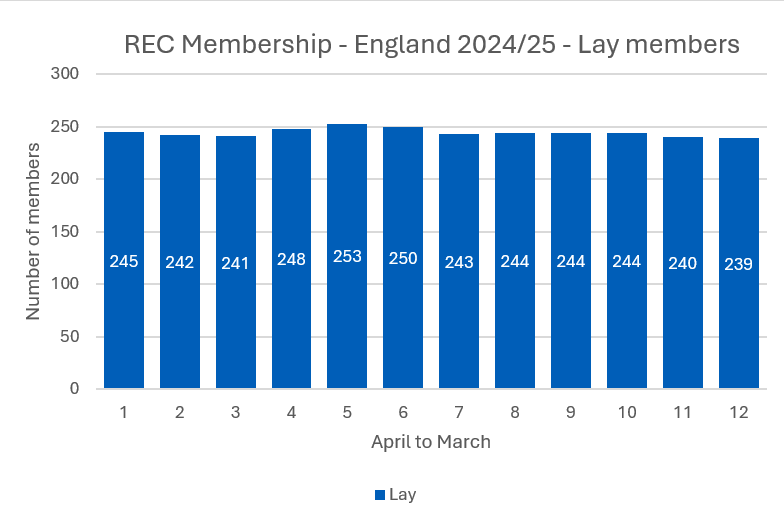
Download a csv file for figure 1a.
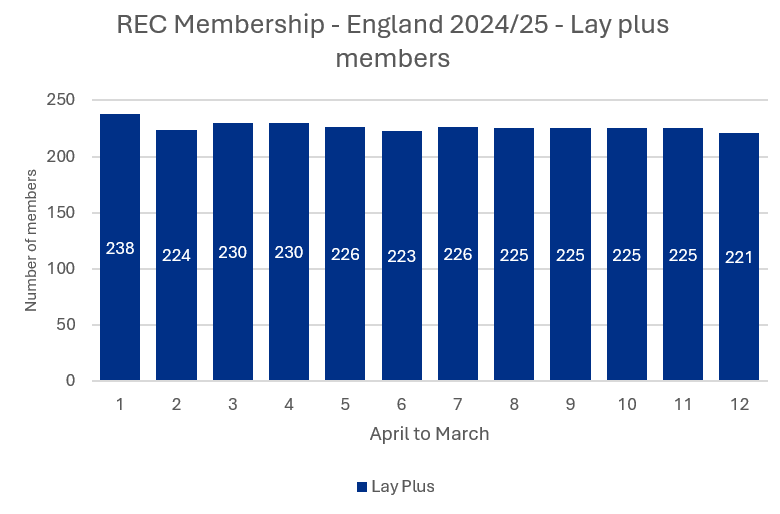
Download a csv file for figure 1b.
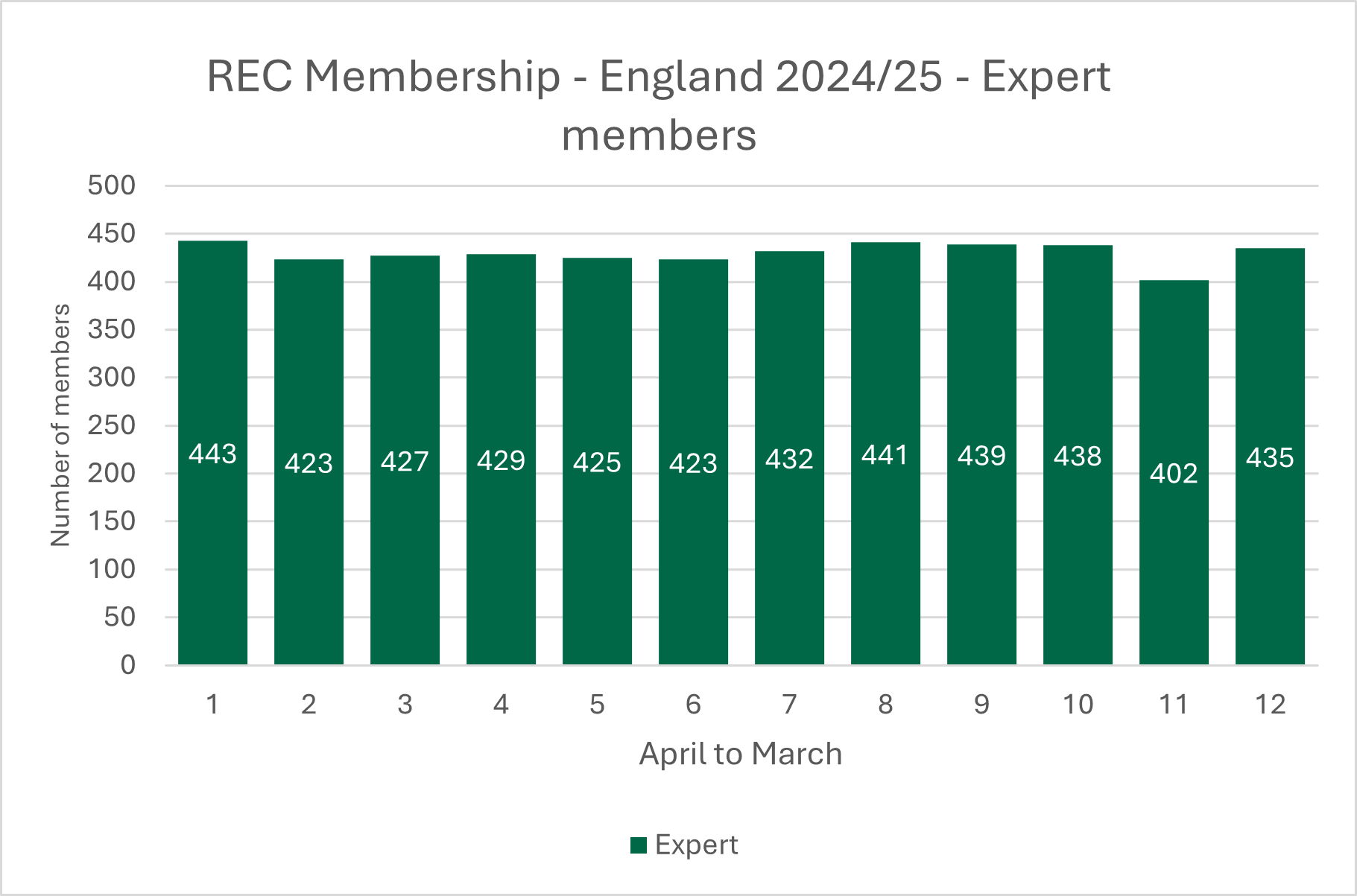
Download a csv file for figure 1c.
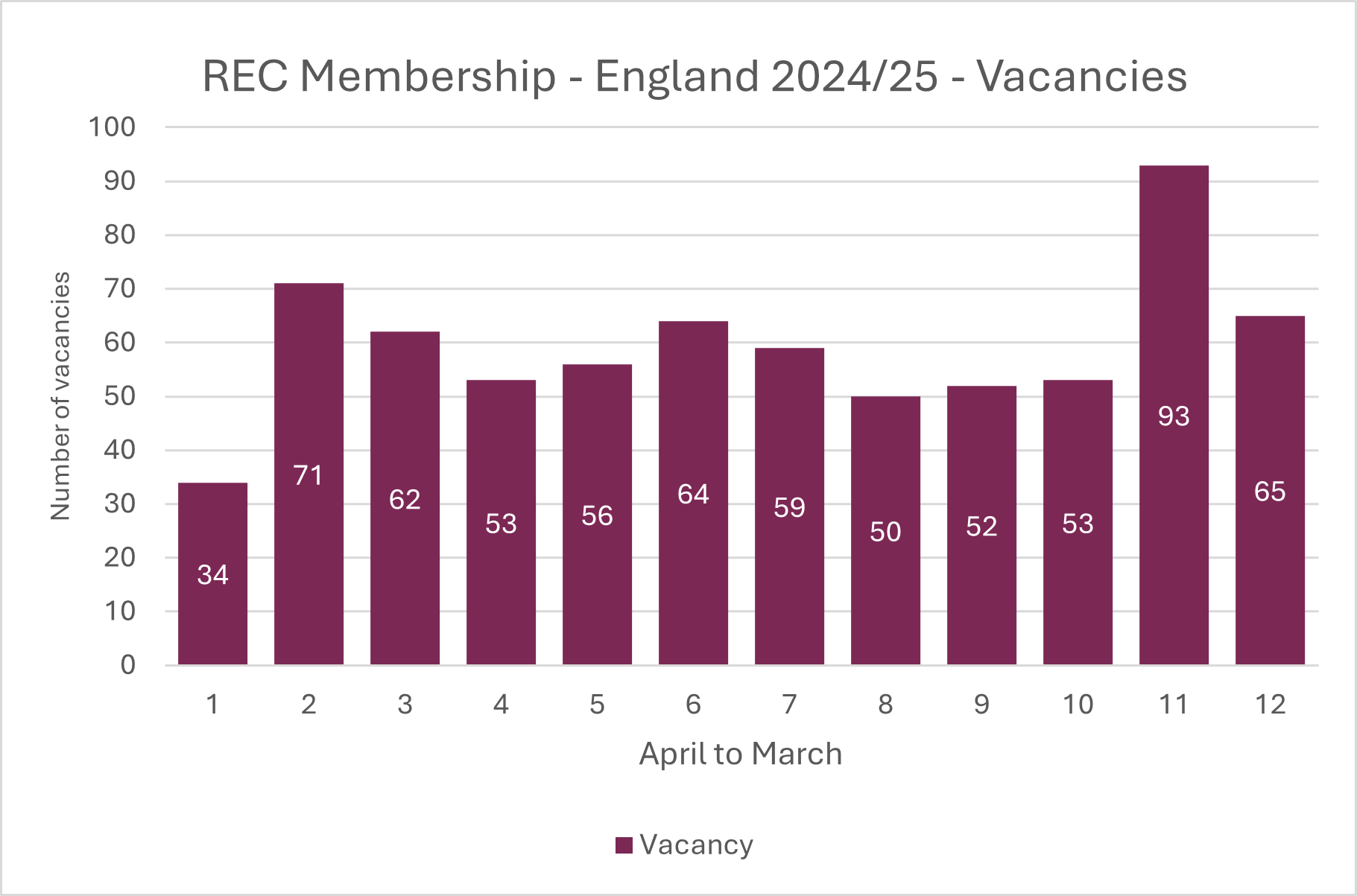
Download a csv file for figure 1d.
The approvals directorate operates a co-option process whereby members from across the REC service attend other REC meetings to ensure meeting quorum is achieved. During the reporting period, 86 formal co-option requests to co-opt a total of 108 REC members were processed.
Despite the large overturn in REC members, the recruitment activity and the provision of a co-option service ensured that the majority of REC meetings were quorate, and the RECs were able to issue an opinion in a timely manner.
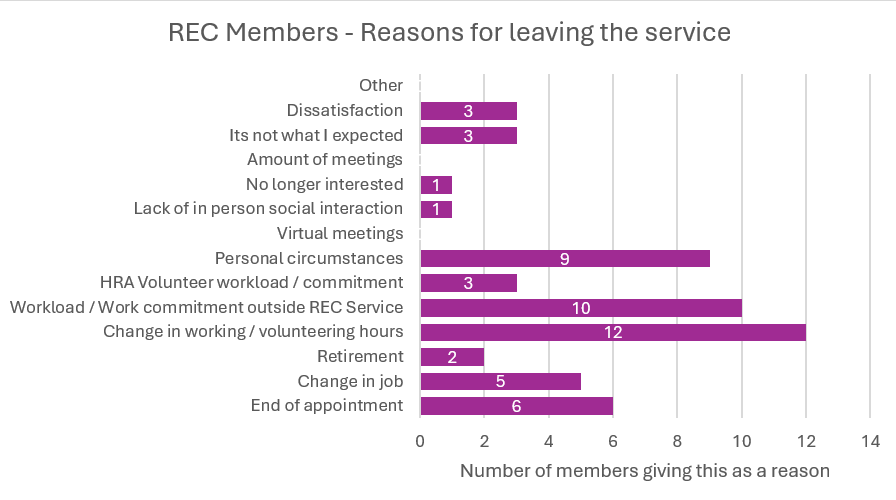
REC member retention
The information detailed in the section above, demonstrates the large turnover in REC members that the Research Ethics Service experiences due to the voluntary nature of the role and external socio-economic factors.
Whilst the response rate is low, data from the REC Members’ leavers survey detailed in the figure 2, demonstrates that HRA volunteer workload/commitment and workload/workload commitment outside the REC service are 2 two main reasons for leaving.
Download a csv file for figure 2.
In response to REC member feedback, the approvals directorate launched a long service award scheme in June 2024. The scheme recognises REC members who achieve 5, 10, 20 and 30 years of REC service with a badge and a certificate. Those who achieve 20 and 30 years of service receive their award at a REC development day.
For the first time in June 2024, we successfully launched the NHS discounts for our members. We have worked with an NHS Discounts provider to make this possible.
REC member learning and development
The approvals directorate, with the support of the HRA’s learning and development team, provide a comprehensive learning and development programme for REC members, starting with induction and then progressing to topic-specific learning such as, research involving adults lacking capacity and CTIMPs. Below are some of the key learning and development activities during 2024/25:
REC mentor scheme
The REC mentor scheme was introduced in 2021 to support new REC members in their role. During the reporting period, 36 REC mentor groups were established. Each group contains up to eight new members and is overseen by an experienced REC member. The mentor group meets three to four times over a period of 6 months. The mentors will deliver core learning but also tailor the sessions according to the group’s learning needs.
"It was very useful to have [a] number of sessions with the group. Bit by bit they [the members] grew in confidence. They asked excellent questions on how to improve their review process to be more efficient." - REC Mentor
Induction workbooks
Two new electronic workbooks were launched to support new REC members. The first workbook aims to help new members get set up in their REC member role and includes practical advice regarding induction training, working in a virtual environment, and what to expect at their first REC meeting. The second workbook explains the role and remit of a REC and introduces members to health and social care research applications.
The ethical aspects of research involving children and young people: a case based advanced workshop for REC members
To build on the success of the introduction to research involving children and young people learning module, an advanced learning session was introduced. Feedback from those who attended was positive:
‘Really challenging and relevant session - glad I attended.’
Introduction to qualitative research
This session was designed and delivered by a Professor from Mary Kinross Trust and Royal College of Surgeons Chair in Surgical Trials and Health Sciences, University of York and introduced REC members to qualitative research methods as applied to health and social care research. The session discussed basic concepts including research questions appropriate for qualitative research, data collection methods, sampling and recruitment, and qualitative data analysis.
Adult social care workbook
This workbook introduces REC members to adult social care; what it is and who provides care both informally and through care services.
Reviewing a MCA study in a care home workshop
A REC Chair and Professor at the School of Allied and Public Health Professions at Canterbury Christ Church University ran an online session for members to better understand ethical considerations for social care research taking place in a care home, specifically all safeguards set out in the MCA, including the role of the Personal Consultee and its limitations, and the considerations for observing residents in a care home.
REC Chair support and development
The approvals directorate are committed to supporting and developing REC Chairs. Below are some of the learning and development activities that took place during the reporting period:
REC Chairs meetings
REC Chairs were invited to attend 2 online meetings with senior HRA managers during the reporting period: 1 in the spring and 1 in the autumn of 2024. The meetings allow the approvals directorate to provide the REC Chairs with essential information and an opportunity to raise any issues they are experiencing with their RECs and the ethics review of health and social care research applications.
The meetings held during the reporting period covered the following topics:
- HRA Strategy
- amended clinical trials regulations and REC membership
- Research Systems programme
- Artificial Intelligence and ethics review
- CTIMPs involving healthy volunteer and patient cohorts
- user satisfaction reports
National Chairs Day
Following feedback from REC Chairs, the National Chairs’ Day was reintroduced on the 5 March 2024.
In addition to receiving important updates, the programme included a talk from a Professor of the Public Understanding of Philosophy, University of Sheffield on ethical decision making, and Senior Partner from Ignite your Inner Potential on building a high performing online team.
REC Reviews
In 2024/25, a total of 9,808 applications and substantial amendments were reviewed. This figure includes 2,123 new applications, 922 proportionate review applications and 6763 amendments. This high volume is in line with previous years, however, overall, the application volume has increased by 4% compared with the previous year.
Applications reviewed at full REC meetings
Table 1 shows the number of applications reviewed at a full REC meeting. The number of applications reviewed at full REC meetings decreased by 14% compared with the previous annual reporting year. However, this was expected due to the changes made to the Proportionate Review service. Overall, application numbers for studies requiring an NHS REC review decreased by 7%.
During the reporting period, all RECs scheduled 10 full REC meetings and either 3 or 4 application slots made available for each meeting.
| Type of study | Number reviewed |
Median time to final opinion |
% Reviewed in less than 60 days |
| CTIMP | 609 | 33 | 100% |
| Non-CTIMP | 1334 | 29 | 98% |
| Research Database | 83 | 25 | 98% |
| Research Tissue Bank | 48 | 20.5 | 96% |
| Total | 2123 | 29 | 98% |
Download a csv file for table 1.
(*The clinical trials regulations specify that the REC must give its opinion in 60 days. The data for CTIMPs reflects the timeline for the ethics review only. It is not the timeline for the combined review outcome which also includes the decision from the MHRA. The median time is used in performance reports in order that the data is not skewed by any outliers. These timelines do not include any time the clock is paused whilst waiting for the sponsor to respond to a Request for Further Information (for a CTIMP) or Provisional Opinion (for all other study types).
Applications reviewed by proportionate review sub-committees
The approvals directorate recognises that some research applications require REC review but due to the type of research being carried out, will not raise material ethical issues. Proportionate review allows the directorate to apply a proportionate approach whereby research applications that do not contain material ethical issues are reviewed by a subcommittee of three or more REC members. The number of proportionate review applications reviewed in 2024/25 increased by 12% in comparison with the previous year, this increase was expected due to the change in the way HRA staff screen applications for proportionate review.
| Number reviewed |
Median time to final opinion |
% Reviewed in less than 21 days |
Number reviewed |
| 922 | 20 | 67% | 922 |
Download a csv file for table 2.
Substantial amendments
Substantial amendments are changes to research that has received a favourable opinion. The changes are likely to affect the safety, scientific value, conduct/management or quality of the research. Substantial amendments are reviewed by a sub-committee of 2 or more REC members. During the reporting period, the number of substantial amendments submitted for REC review increased by 12%.
| Type of study | Number reviewed |
Median time to final opinion |
% Reviewed in less than 35 days |
| CTIMP | 3765 | 20 | 86% |
| Non-CTIMP | 2623 | 20 | 89% |
| Research Database | 60 | 19.5 | 95% |
| Research Tissue Bank | 78 | 19.5 | 92% |
| Total | 6763 | 20 | 88% |
Download a csv file for table 3.
Fast-track ethics review
We offer a fast-track ethics review service for research applications that need a rapid research ethics review. Fast-track ethics review is open to global clinical trials and phase I trials whether the sponsor is commercial or non-commercial. This includes:
- any Clinical Trial of an Investigational Medicinal Product (CTIMP) led from UK with at least one other country participating
- any CTIMP led from outside the UK which could be placed in any country and the UK is competing for participation (including any only taking place in the UK)
- any phase I or phase I/II CTIMP in healthy volunteers or patients
The service offers several benefits: a faster review time from submission to decision, the ability to pre book a meeting slot ahead of time and submitting the application up to seven days prior to the meeting (rather than having to submit the documents at the time of booking/reserving the slot). During the reporting period, 15 RECs in England offered this service.
|
Number reviewed as part of fast-track ethics review |
Median time to final opinion |
% Reviewed in less than 60 days |
| 237 | 26 | 100% |
Download a csv file for table 4.
Decisions at full review
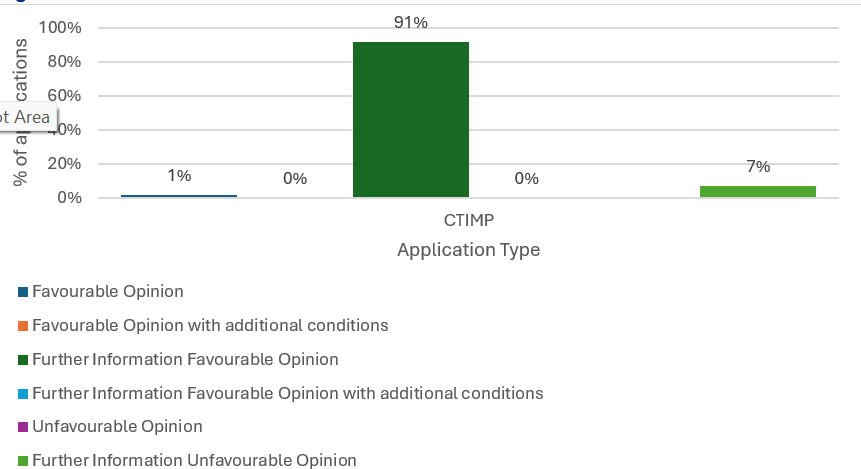
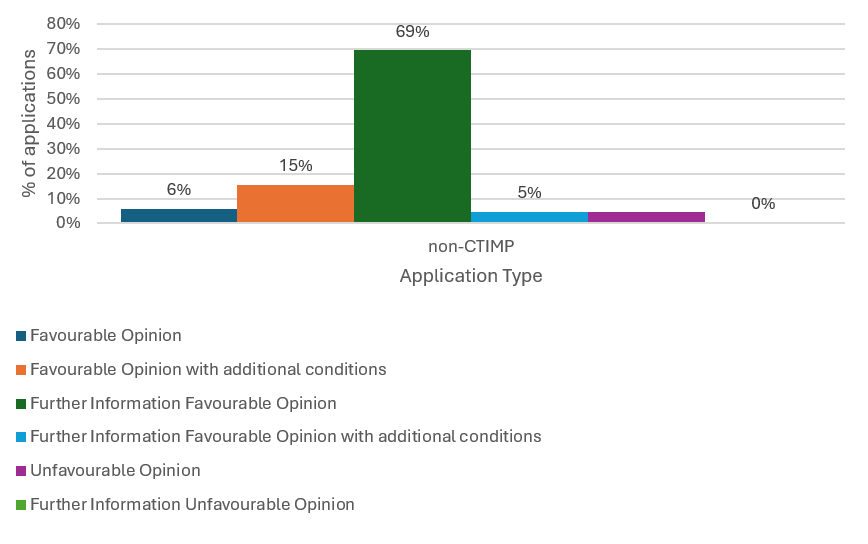
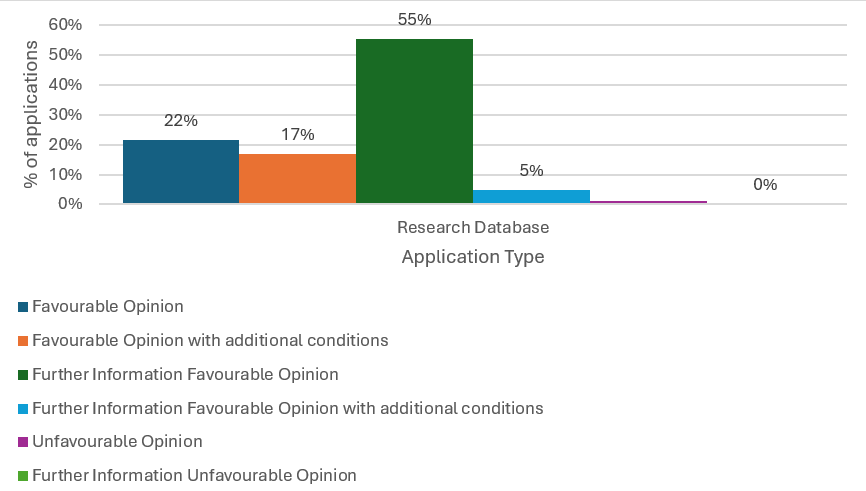
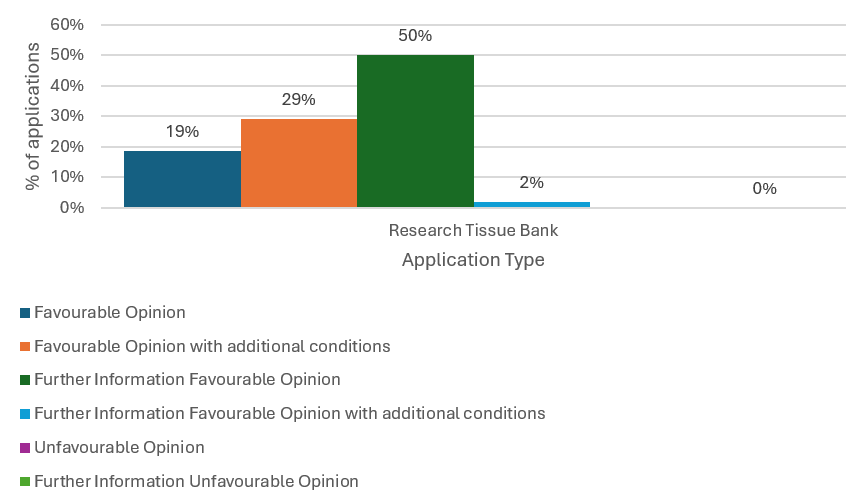
Figure 3 shows the decisions issued by RECs at full REC meetings during the reporting period. In most circumstances it is not possible for a CTIMP to be given an outright favourable (or unfavourable) opinion at the first review, instead they are given a provisional opinion in HARP to enable the MHRA to issue a request for further information as part of the combined review process. The very small number which have an outright favourable opinion are resubmissions following a rejection.
Download a csv file for figure 3a.
Download a csv file for figure 3b.
Download a csv file for figure 3c.
Download a csv file for figure 3d.
Decisions at PR sub-committee
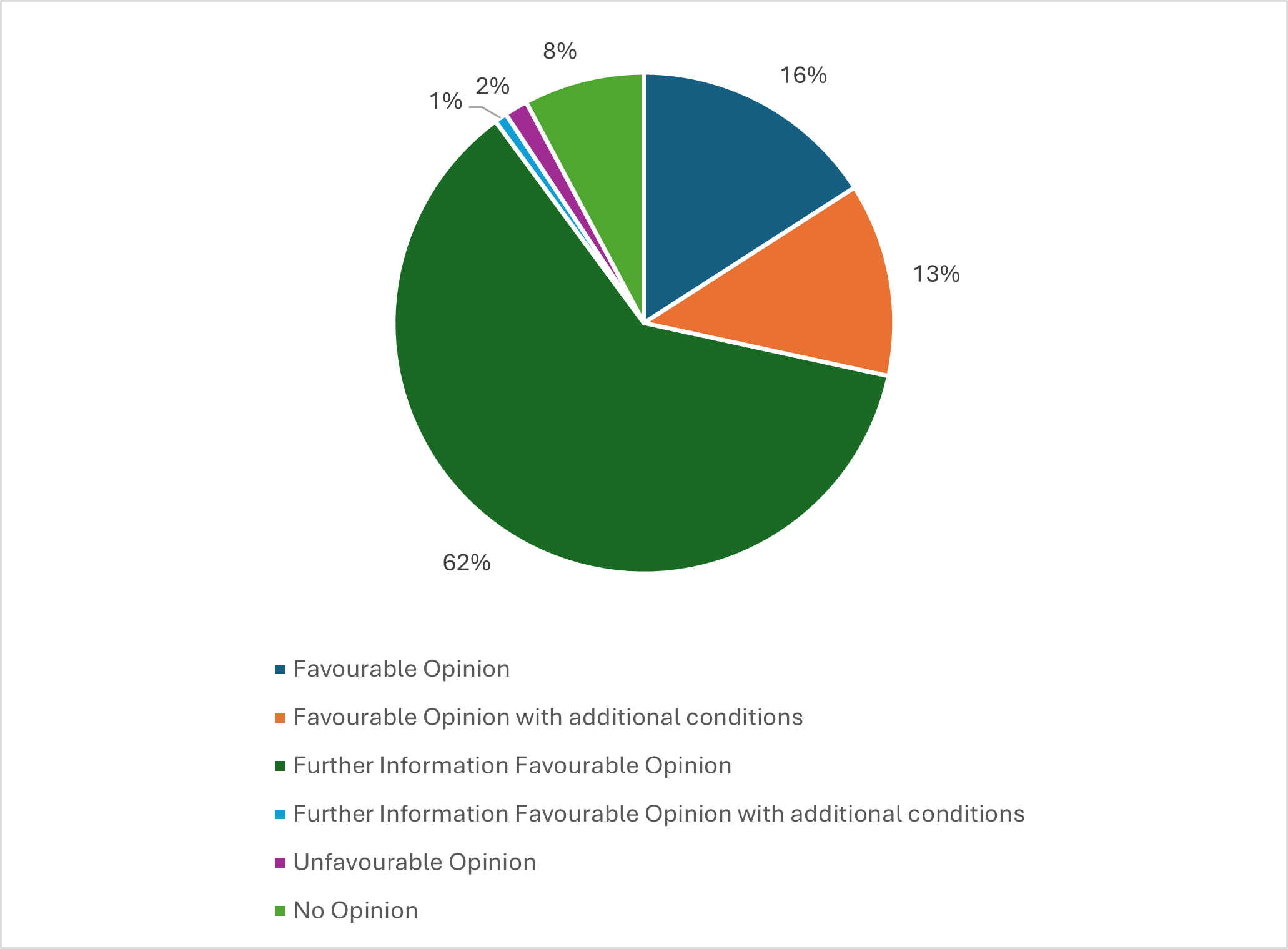
Figure 4 shows the decisions issued by the RECs at a proportionate review sub-committee meeting during the reporting period. Applications that receive a ‘No opinion’ are transferred to a full REC meeting as they have been deemed to have material ethical issues. The rate of no opinions has increased slightly since 23/24 from 7% to 8%.
Download a csv file for figure 4.
Generic Review Committee
This is a small committee of two members which provides an ethics opinion on generic recruitment documents for Phase 1 trials. As well as new submissions, the Generic Review Committee (GRC) also receives amendments to previously approved submissions. Excellent feedback has been received from the Phase I Advisory Group regarding the service provided by the GRC.
| Type of Application | Number reviewed |
Median review time to final opinion |
| New Submissions | 92 | 4 Days |
| Amendments | 83 | 2 Days |
Download a csv file for table 5.
Appeals
If an application requiring REC review receives an unfavourable opinion, the applicant can appeal the decision. This means that the same application will be reviewed by a second REC.
Five requests for appeals were received during the annual reporting period. All the requests to appeal were allowed and all five applications received a favourable opinion from the second REC (4 of these received a provisional opinion first followed by a favourable opinion and one application received a favourable opinion with conditions at first review). These decisions are relayed back to the original REC along with any lessons learned to help inform their review process.
If a request for appeal regarding an amendment is received and allowed, a second REC is identified to review the amendment. The comments are then shared with the original REC, which then re-reviews the amendment and the comments from the second REC to issue a final decision. Therefore, the decision remains with the original REC. One amendment appeal was received during the annual reporting period, which was allowed and received a favourable opinion.
Breaches
A ‘breach’ is a general term related to any non-compliance with the approved study protocol or of the principles of Good Clinical Practice.
The HRA categorises ‘Breaches’ as one of the following:
- Serious breach - A serious breach of the protocol or of the conditions or principles of Good Clinical Practice (or the UK Policy Framework for Health and Social Care Research for the conduct of non CTIMPs) which is likely to affect to a significant degree:
a) the safety or physical or mental integrity of the trial subjects; or
b) the scientific value of the research.
- Protocol violation - Variations from the protocol which are not agreed in advance, or which deviate from the principles of Good Clinical Practice and are the result of error, but do not constitute a serious breach
- Fraud and/or misconduct - Intentional behaviour by a researcher, either alleged or proven, that falls short of good ethical and scientific standards, or the generation of false data with the intent to deceive
When a breach is reported to have occurred in an approved study, there should be consideration for the actual categorisation of ‘serious’ – the categorisations of submitted breaches are either defined by the sponsor, the REC or the HRA and can be open to further consideration.
It is a condition of the REC favourable opinion that the sponsor notifies the REC of a serious breach within seven days of the incident coming to their attention. Breaches reported to the HRA are recorded on a breach register adhering to internal policy and process. The breach is reviewed by the REC who will consider what corrective, and preventative actions have been taken and the ethics, including information provided to participants and any impact on consent obtained prior to the breach.
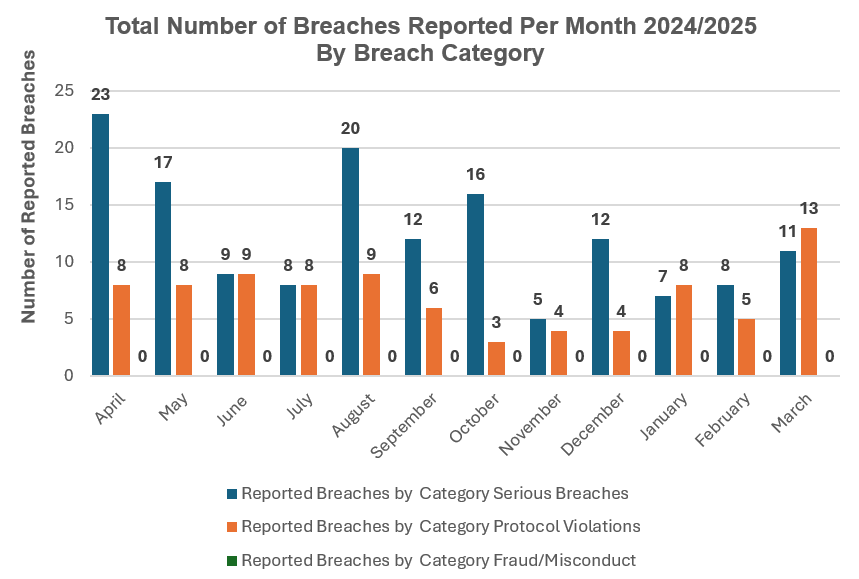
The number of breaches, including protocol violations and serious breaches, has increased slightly from 226 in 2022/23 to 233 in 2024/25. No breaches of fraud/misconduct have been received during the reporting period.
Figure 5 demonstrates the number of breaches reported each month according to their categorisation during the reporting period.
Download csv file for figure 5.
Accreditation scheme for the audit of RECs
The accreditation scheme audits on the standards that relate directly to RECs as set out in GAfREC and the Standard Operating Procedures for RECs. The standards checked as part of the audit include a review of the constitution of the REC, member and chair appointments, member training and member attendance, and a quality check of REC meeting outputs (minutes and decision letters). The scheme runs on a two-year rolling cycle of audits.
All RECs audited during the annual report period achieved their accreditation. When a REC received an action plan to complete before achieving accreditation, the most common action related to REC membership, for example, members not completing their annual training and/or attendance requirements.
Identifying trends
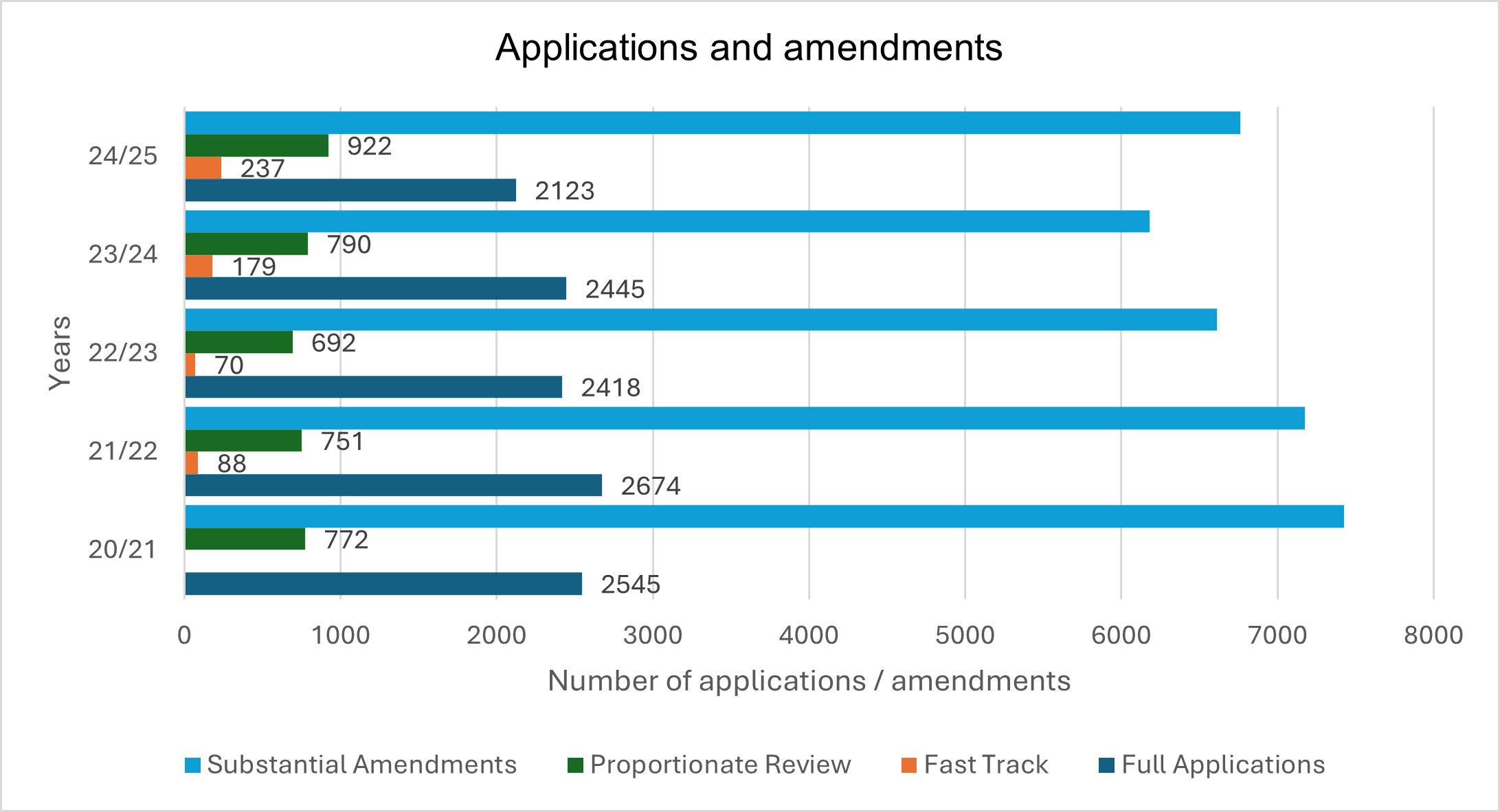
Whilst comparing data with the previous reporting period is helpful, reviewing data over a period of five years helps identify trends and informs business planning. As demonstrated in Figure 6 and 7, we can identify the following trends:
- overall, the number of full applications has fluctuated around 2,500 but the number of non-CTIMP applications has declined
- as anticipated, Proportionate Review applications have increased substantially
- amendments were declining slightly but have increased during this reporting period
- amendments continue to constitute a substantial proportion of the workload for the REC Service
- fast track applications are increasing substantially
As detailed in the REC membership section, REC membership is stable due to continual recruitment, but the service continues to experience a high turnover rate.
Download csv file for figure 6.
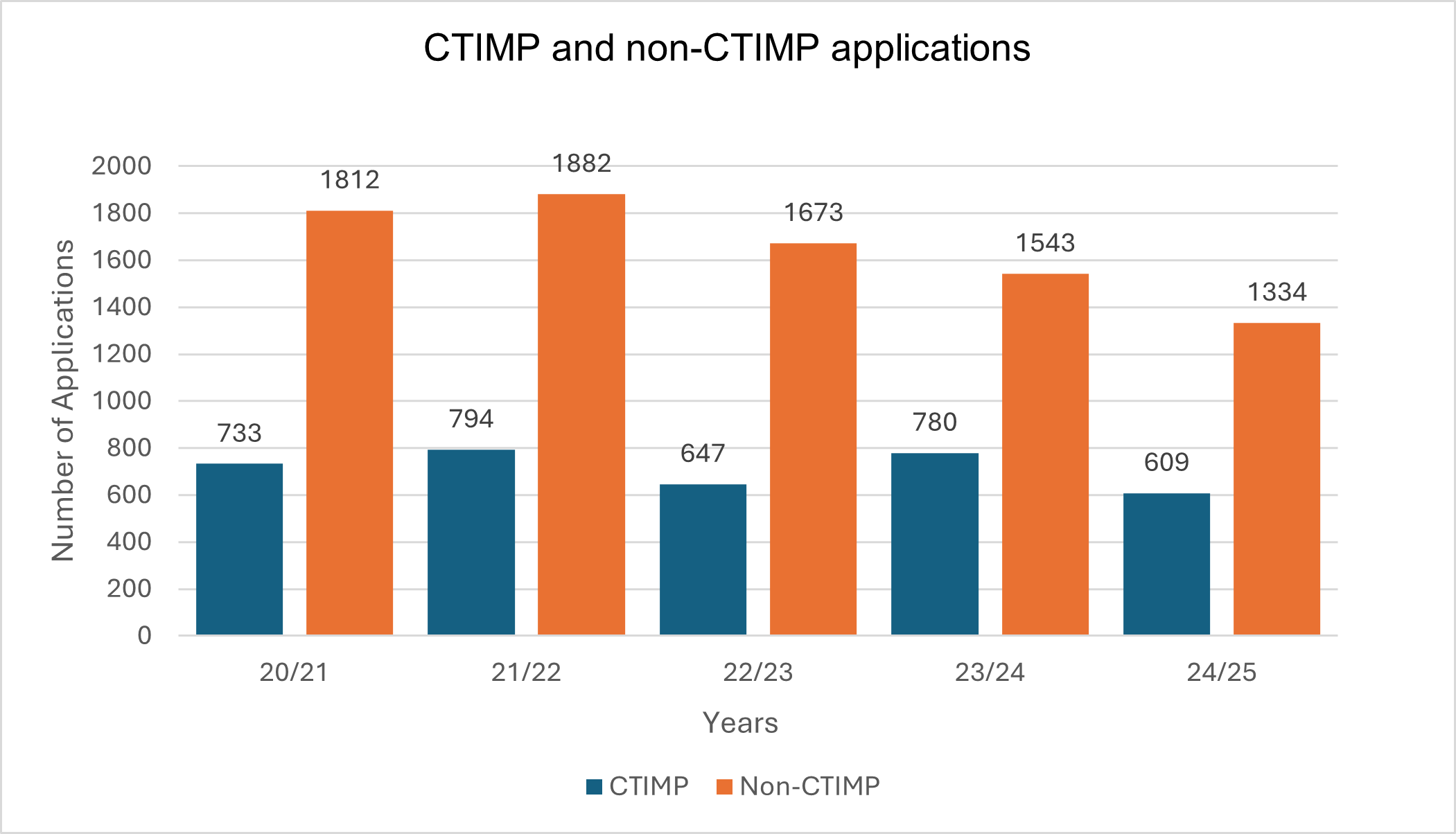
Download csv file for figure 7.
Conclusion
As evident from this report, the Research Ethics Service in England completed a substantial amount of work during 2024-2025 to support and promote ethical research in the UK, as part of a UK wide Research Ethics Service. The HRA is extremely grateful to its REC members and staff for all their hard work - such an amazing achievement.
The report demonstrates not only the work undertaken to ensure that applicants receive an opinion within a timely manner whilst ensuring a high standard of review, but also the work undertaken to continually improve the service.
The approvals directorate is committed to further streamlining its processes and supporting the HRA in the development and implementation of its digital services to improve the service it provides to researchers and to reduce the burden on REC members.
Next year we look forward to some challenges and exciting opportunities, including implementing the amended Clinical Trials Regulations, undertaking work to better understand how to support RECs in reviewing studies that use Artificial Intelligence (AI) and supporting HRA thinking about how we can harness AI and other IT resources to help streamline our processes too.
Together we deliver a responsive service to ensure that ethical research can take place, and the results inform health and social care as quickly as possible.